



Plastic in your food sounds like something that only creeps in via packaging or polluted water. But microplastics in the kitchen largely come from kitchen items themselves. Scientists now call the kitchen one of the most underestimated sources of daily exposure to microplastics. Which items are the worst offenders, and what can you do about it?
In this overview you will read which ten kitchen accessories release microplastics, what research says about them, and how you can reduce exposure for yourself and your family.
Why microplastics in the kitchen are such an underestimated problem
Microplastics are plastic particles smaller than five millimetres. They are released when plastic wears, is heated or is mechanically damaged. Those are exactly the conditions that occur every day in every kitchen: cutting, stirring, heating, washing.
According to an estimate from research by Cox et al. (2019), published in Environmental Science and Technology, people take in between 39,000 and 52,000 microplastic particles a year through food and drink. A considerable part of that exposure happens directly in the kitchen. In scientific review studies, researchers explicitly point out which kitchen items release microplastics: from cutting boards and non-stick pans to tea bags and kitchen sponges.
What do we know about the consequences? Microplastics have now been found in human blood, lungs, placenta and brain tissue. A clinical study in the New England Journal of Medicine (Marfella et al., 2024) showed that people with microplastics in their artery wall had a significantly higher risk of heart attack and stroke. The science is still in full swing, but the direction is clear enough to be cautious.
The 10 kitchen items that release microplastics
1. The plastic cutting board
This is the best-known and most researched source. Research by Yadav et al. (2023), published in Environmental Science and Technology, shows that a plastic cutting board can release up to 50 grams of microplastics per person per year with daily use. Polypropylene boards release 14 to 71 percent more particles than polyethylene boards. Most particles are smaller than 100 micrometres and land directly on and in the food you prepare.
Scientists at North Dakota State University confirm that the particles are actually found in the food itself: microplastics were recovered from carrots after they had been cut on a plastic board. The researchers mention plastic cutting boards and microplastics in the same breath: the board is literally "an overlooked source".
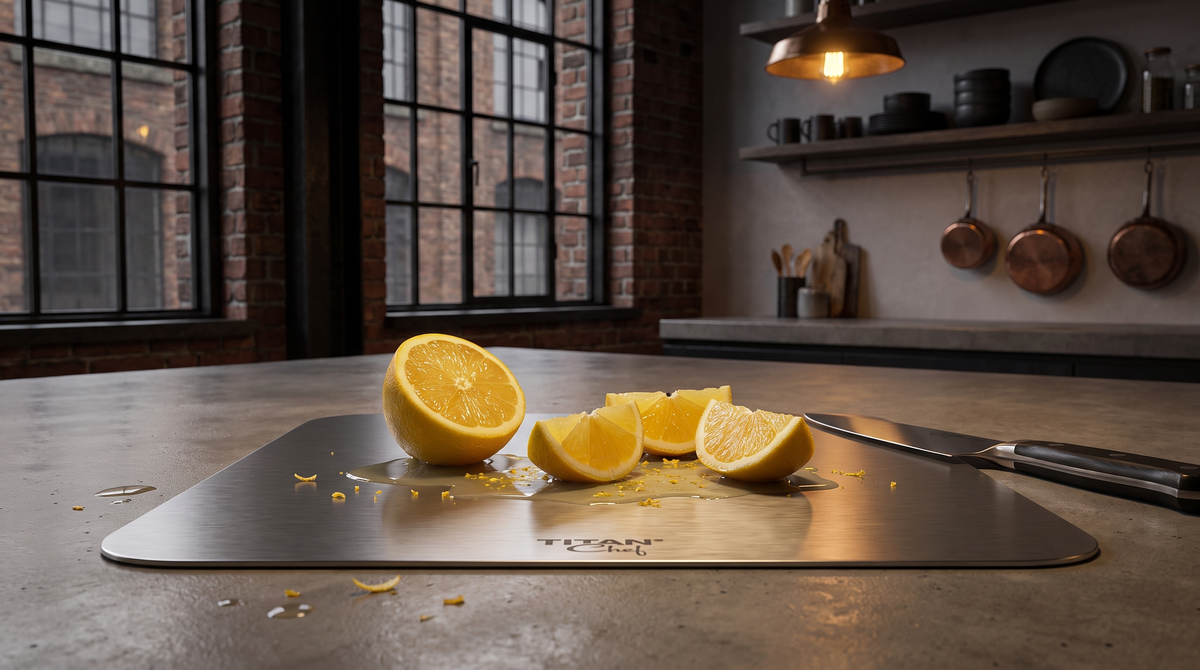
An alternative without this risk is a stainless steel cutting board. Stainless steel does not wear under a knife the way plastic does, so no particles end up in the food. The comparison between a stainless steel cutting board and a plastic cutting board clearly favours stainless steel on this point.
2. The damaged non-stick pan
Non-stick pans with a Teflon coating are made of PTFE, a substance belonging to the PFAS family. Australian research by the University of Newcastle and Flinders University showed that a damaged non-stick coating releases large amounts of micro- and nanoparticles when heated. Researchers describe it as a serious warning: anyone who uses a damaged non-stick pan risks microplastics and PFAS particles in their food.
A small scratch is enough to speed up the process. Never use metal spatulas or sharp utensils in a Teflon pan, and replace a pan with visible wear straight away. Ceramic or cast iron pans are alternatives without a PTFE coating.
3. Plastic containers in the microwave
Plastic heating bags and containers are a particularly active source of microplastics in the microwave. Research shows that five minutes of heating in the microwave can release 326,000 to more than 500,000 micro- and nanoplastic particles. That is up to seven times more than when heating in a regular oven. Damaged or previously used containers release almost twice as many particles as new packaging.
Labels such as "microwave safe" say nothing about the amount of microplastics released: they only refer to structural resistance. Always move food to a glass or ceramic dish before heating it.
4. Plastic tea bags
Many tea bags are partly or entirely made of plastic. Researchers at McGill University tested plastic tea bags and found an average of 11.6 billion microplastic particles per cup of tea. Pyramid-shaped tea bags made of nylon or PET plastic are the worst offenders. But "paper" bags can also contain a layer of polypropylene to help the material hold together in hot water.
Scientists at the Universitat Autònoma de Barcelona discovered in 2024 that the released particles are absorbed by human intestinal cells and may end up in the bloodstream. Brewing loose tea with a stainless steel strainer is the most direct way to avoid this.
5. Kitchen sponges
The green and yellow kitchen sponges found in almost every kitchen are largely made of synthetic foam. Particles of the material come loose during use and washing. Scientists confirm that washing-up sponges are a known source of microplastics in the kitchen. The particles end up on cutlery, plates and pans via the washing-up water.
Alternatives are dish brush heads made of plant-based material, or compostable sponges. In combination with a dishwasher, a sponge is unnecessary for a lot of kitchen work anyway.
6. Plastic kitchen utensils
Spatulas, ladles, stirring spoons and other plastic utensils visibly wear over time. That worn material goes straight into the food. Scientific review research (ScienceDirect, 2024) confirms that which kitchen items release microplastics partly depends on temperature: heating plastic kitchen tools greatly speeds up wear. A rubber spatula in a hot pan or a plastic stirring spoon in a simmering dish are typical situations in which particles come loose.
Wooden, bamboo or stainless steel alternatives are the obvious choice here. With stainless steel you also keep the advantages of a non-porous surface: no bacteria and no odours settling into it.
7. Plastic drinking bottles and water bottles
Plastic drinking bottles release microplastics even with normal use, but the amount increases sharply with repeated opening and closing, with heat and with mechanical damage. Research shows that even repeatedly opening a bottle contributes to microplastic release via the cap and closure mechanism. Use a glass or stainless steel bottle as an alternative, especially for hot drinks.
8. Plastic kettles and coffee makers
Kettles and coffee makers with plastic interiors are exposed to boiling water. That is exactly the combination of heat and moisture in which plastic particles come loose. When replacing one, look for a kettle with a fully stainless steel interior, or choose a glass version.
9. Plastic food storage containers
Plastic storage boxes are regularly exposed to moist food, acids (such as tomato sauce or citrus) and sometimes heat. All those factors speed up the release of microplastics. Older or scratched containers are risky: wear considerably increases the number of particles released. Glass storage containers with a clip-on lid are a direct replacement that solves the problem.
10. Plastic sieves and colanders
Plastic sieves and colanders are exposed to boiling or hot water when draining pasta, vegetables or pulses. The combination of heat and mechanical stress causes particles to be released. Because hot water comes into direct contact with the plastic, there is a good chance that particles end up on the drained food. A stainless steel sieve or colander costs hardly any more and eliminates this risk completely.
Preventing microplastics in the kitchen: where do you start?
If you want to prevent microplastics in the kitchen, you do not need to replace everything at once. Start with the items you are in direct contact with every day while preparing food. The cutting board is at the top of that list: it is where knife, food and surface come into contact most intensively.
A stainless steel cutting board does not release plastic particles. The surface is non-porous, does not hold on to odours or bacteria, and simply goes in the dishwasher. Making the switch from plastic to stainless steel removes one of the most active sources of microplastics from your daily kitchen routine. You can read more about choosing a suitable cutting board in the article about the pros and cons of different cutting board materials.
Next: replace damaged non-stick pans, never heat food in plastic containers again, and switch from plastic tea bags to loose tea. Small choices that together make a noticeable difference to the amount of microplastics you take in through food every day.
Looking for a cutting board without plastic? The TitanChef Original is made of 304 stainless steel and does not release microplastics.
Want to know more? Also read are microplastics harmful to your health?
Frequently asked questions about microplastics in the kitchen
How many microplastics are released when you cut on a plastic cutting board?
Research by Yadav et al. (2023), published in Environmental Science and Technology, shows that a polypropylene or polyethylene cutting board can release up to 50 grams of microplastic per person per year during normal daily use. That is millions of individual particles, most of them smaller than 100 micrometres. The amount depends on cutting style, wear of the board and how often you use it.
Are microplastics in your food dangerous to your health?
Researchers now find microplastics in places in the body where plastic should never have reached: in blood, lungs, placenta and recently also in brain tissue. A clinical study in the New England Journal of Medicine (Marfella et al., 2024) showed that people with microplastics in their artery wall had a significantly higher risk of heart attack and stroke than people without. Exactly how serious the long-term consequences are is still being researched extensively. The indications are serious enough to be cautious.
Does it matter if you use a damaged non-stick pan? Are more microplastics released?
Yes, definitely. Australian research by the University of Newcastle and Flinders University showed that a damaged non-stick coating releases considerably more micro- and nanoparticles when heated than an intact pan. The non-stick coating consists of PTFE, a substance from the PFAS family. A damaged Teflon pan is best replaced straight away: both because of the microplastics and because of the PFAS particles released during use.
Are there also microplastics in tea bags and kitchen sponges?
Yes, in both. Research by McGill University showed that plastic tea bags can release an average of 11.6 billion microplastic particles per cup on contact with hot water. Pyramid-shaped bags made of nylon or PET plastic are the worst offenders. Kitchen sponges are also a known source: the foam layer is made of synthetic material that constantly releases particles during use and washing, which end up on your kitchenware via the washing-up water.
Does a plastic container in the microwave release microplastics into your food?
Yes, and in large amounts. Research shows that heating a plastic container in the microwave can release between 326,000 and more than 500,000 micro- and nanoplastic particles within five minutes. That is up to seven times more than when heating in a regular oven. Damaged or reused containers also release almost twice as many particles as new packaging. Always move food to glass or ceramic before heating it.
Do microplastics from a cutting board disappear if you wash the meat or vegetables?
No, washing does not remove the microplastics that have already ended up in the food. The particles released during cutting are partly embedded in the surface of the food itself, and partly so small that they do not rinse off with water. The only effective solution is to prevent the particles from being released: you do that by cutting on a material that does not shed plastic, such as stainless steel or wood.
Is a stainless steel cutting board really microplastic-free, or does it also release particles?
A stainless steel cutting board does not release microplastics. Stainless steel is a non-porous metal that does not wear under a knife the way plastic does: no plastic particles end up in your food. The TitanChef stainless steel cutting board is made of food-grade 304 stainless steel, a material that is standard in professional food processing because of its hygienic and wear-resistant properties.
Conclusion
The kitchen is full of items that release microplastics, from the plastic cutting board and the damaged non-stick pan to tea bags and microwave containers. Scientific research confirms this ever more emphatically, and the health indications are serious enough to take action. You do not have to tackle everything at once. Start with the items that are in direct contact with your food every day, and replace them step by step with materials that do not shed plastic.
The cutting board is a logical first step: one of the most active sources of microplastics in the kitchen, and at the same time one of the easiest to replace.
Curious about the TitanChef stainless steel cutting boards? Take a look below. You will also find more blogs to read there.


