



You cut your vegetables on it every day, prepare your meat on it, and rinse it off for the next ingredient. The plastic cutting board is so ordinary in most kitchens that nobody gives it a second thought. But what actually happens with a plastic cutting board, microplastics and your body has come into ever sharper focus in recent years. Scientists call the cutting board an "overlooked source" of microplastics in food, and research into the consequences keeps piling up.
This article explains what happens step by step: from the moment your knife touches the board to the organs where those particles are eventually found. No alarmism, just the facts as they stand today.
How a plastic cutting board brings microplastics into your body
Plastic cutting boards are almost always made of polyethylene (PE) or polypropylene (PP), two relatively soft plastics. Every knife that crosses the surface cuts loose microscopic particles. The process is invisible to the naked eye, but easy to measure in the laboratory.
In 2023, researchers at North Dakota State University published a study in the scientific journal Environmental Science and Technology which showed that cutting carrots on polyethylene and polypropylene cutting boards can release as many as 79 million plastic particles per year. Those are not small numbers. Expressed in weight: such a board can release about 15 milligrams of microplastics per vegetable cut, which comes to about 50 grams per year.
Research shows that about 50 percent of the released microplastics stay on the cutting board after cutting and go down the drain when washing up. The other 50 percent is consumed. In other words, they are swallowed along with the food you have just prepared. That is where the problem starts.
What a scratched plastic cutting board adds to the microplastics in your body
A new plastic cutting board already releases microplastics. But the amount of plastic particles released depends, among other things, on the material and age of the cutting board and on how much force you put on the knife. In concrete terms: as the board gets older and more scratched, the release increases. Scratches enlarge the contact surface, which means more material comes loose with every cut.
The amount of microplastics released from polypropylene boards is 5 to 60 percent higher by mass and 14 to 71 percent higher by number of particles than with polyethylene. So the material of your board already matters, even before it has a single scratch. A heavily scratched polypropylene board is therefore the worst combination.
Laboratory research published in the Journal of the Academy of Nutrition and Dietetics (2025) confirms the mechanism: measurements using specialised spectroscopy and electron microscopy confirm that cutting and chopping on plastic boards results in microplastic particles breaking loose.
From gut to blood: how microplastics spread
Once swallowed, the particles end up in the digestive system. The larger fragments probably leave the body via the stool. But the very smallest, the so-called nanoplastics with a diameter of less than one micrometre, behave differently. They are small enough to pass through the intestinal wall and enter the bloodstream.
Heather Leslie, microplastics researcher at the University of Amsterdam, puts the core problem sharply: "We know that our body can remove these particles less quickly than we take them in." That means that years of exposure lead to gradual accumulation, not to a system that neatly cleans itself up.
At the same time, you also partly excrete microplastics again through stool, urine and breathing. So it is not a completely closed system. But with daily exposure through food, the rate of excretion does not keep up with the intake.
Microplastics accumulating in organs: what researchers are now finding
For a long time the question was: where exactly do those particles end up? In recent years the answer has become increasingly concrete. Studies have found plastic in human lungs, placentas, reproductive organs, livers, kidneys, blood vessels and bone marrow.
A clinical study published in the New England Journal of Medicine in 2024 (Marfella et al.) showed that patients treated for atherosclerosis in whom microplastics were found in the artery wall had a higher risk of heart attack, stroke or death from any cause after 34 months, compared with those in whom no plastic particles were found. This is the first clinical study to show a direct association between microplastics in the body and a serious health difference in humans. It is an association, not a proven causal link, but it is the most direct indication so far.
There are also worrying findings about liver tissue. A 2025 systematic review, published via PubMed Central, analysed 25 studies on the effects of microplastics on the human liver and documented that seventeen studies using human liver cells consistently reported oxidative stress, inflammation, cell death, mitochondrial dysfunction and disruptions in fat metabolism, with nanoplastics showing the highest toxicity.
Plastic cutting boards, microplastics and the body: brain tissue as a new frontier
The most talked-about finding of recent years is the presence of microplastics in human brain tissue. Research published in Nature Medicine (2025) by Matthew Campen and colleagues at the University of New Mexico showed that microplastics and nanoplastics accumulate in the human brain in higher concentrations than in the liver and kidneys.
The researchers found considerably higher concentrations in samples from 2024 than in those from 2016. This suggests that accumulation increases over time, in parallel with growing plastic exposure in daily life. It also stands out that larger amounts of microplastics were generally measured in the brains of people with dementia. The scientists found no causal link between the presence of microplastics and the disease, but the research does raise questions about the possible consequences.
In addition, research showed that microplastics can also cross the blood-brain barrier. This filter regulates what can enter the brain from the bloodstream. It used to be thought that only the smallest nanoplastics could pass that barrier, but this research showed that larger microplastics also manage to reach the brain.
It is important to see this in perspective. According to environmental scientist Meiru Wang of Leiden University, there is no immediate reason to panic, but concerns about very small plastics are growing in the scientific world. "Nano- and microplastics affect our health in a way we do not yet understand."
Hormone disruption: the chemical load of plastic
Microplastics bring more than just their physical presence. Plastic contains chemicals added during production: plasticisers, stabilisers and other compounds. These can carry hazardous substances through the body, such as bisphenol A, a substance that can disrupt hormones.
For a detailed explanation of the endocrine-disrupting substances in plastic cutting boards, including BPS and BPF as replacements for BPA, see our blog on why your plastic cutting board can release endocrine disruptors. The essence: plastic is not an inert material. It releases both particles and chemicals, and those two processes run in parallel.
Animal studies have linked microplastics to possible oxidative stress at cellular level, damage to the reproductive system and disruption of the endocrine system. For humans, direct causality has not yet been shown in most cases, but the indications are serious enough to be cautious.
What you can do yourself: a microplastic-free cutting board as a starting point
Microplastics are everywhere: in drinking water, in food packaging, in the air. Some sources are hardly controllable. The cutting board is an exception. It is a kitchen tool you can replace tomorrow, and therefore a source you can switch off straight away.
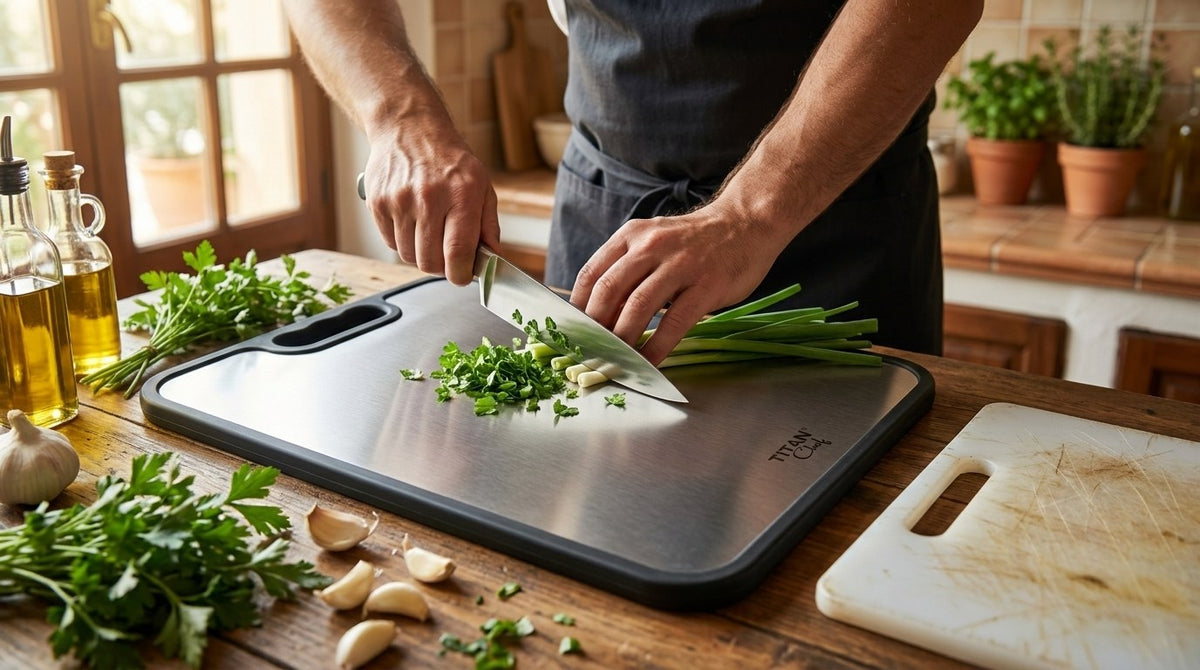
The most direct choice is a microplastic-free cutting board made of stainless steel. Stainless steel is non-porous and does not wear in a way that brings particles into food. The TitanChef stainless steel cutting board is made of 304 stainless steel, food-grade and dishwasher safe. It can be used on both sides, which is practical if you want to keep raw meat and vegetables separate without needing two boards.
If you want to dig deeper into the comparison by material, our blog on the lifespan of cutting boards by material gives a good overview of plastic, wood, bamboo and stainless steel side by side.
The condition of your current board also counts. A heavily scratched plastic cutting board releases more microplastics than a new one, but even an unused plastic board starts releasing particles with the very first cut. That makes the moment of replacement less a question of "when is it too old" and more a matter of principle.
Looking for a cutting board without those drawbacks? Take a look at the TitanChef Original, made of solid stainless steel.
Also read: Plastic-free cutting board: keep microplastics out of your food.
Frequently asked questions about plastic cutting boards, microplastics and your body
How many microplastics do you take in if you cut on a plastic cutting board for years?
Research by North Dakota State University (Yadav et al., 2023) estimates that a polyethylene or polypropylene cutting board can release up to 50 grams of microplastics into your food each year with normal use. Over several years of use, that is a considerable cumulative amount. The exact amount depends on the material of the board, its age and the force with which you cut.
What do microplastics do to your organs when you take them in through food?
Once swallowed, the smallest particles can enter the bloodstream through the intestinal wall and spread from there to organs such as the liver, lungs and kidneys. Research published in Nature Medicine (2025) showed that microplastics accumulate in measurable concentrations in brain tissue. A systematic review on liver tissue documented oxidative stress, inflammation and disruptions in fat metabolism in liver cells exposed to microplastics.
Can microplastics from a cutting board disrupt your hormones?
That is a real concern among researchers. Plastic contains chemical additives, such as plasticisers and bisphenol compounds, which can disrupt hormones. These substances can break loose together with the microplastic particles themselves. Animal research has shown links with disruptions in the endocrine system, but direct causality in humans has not yet been proven. Scientists see this as a reason to be cautious, not as an established diagnosis.
Does plastic leave your body by itself, or does it accumulate?
Both processes play a role, but the balance is worrying. Microplastics researcher Heather Leslie of the University of Amsterdam states that the body can remove microplastics less quickly than they come in. Part is excreted via stool, urine and breathing, but the very smallest particles can penetrate organs and accumulate. That explains why researchers now find plastic in blood, lungs, placenta and brain tissue.
Are scratched plastic cutting boards more dangerous than new ones?
Yes, as a plastic cutting board gets older and more scratched, the release of microplastics increases. Scratches enlarge the contact surface between knife and plastic, which means more particles break loose with every cut. Research confirms that the amount of plastic released depends partly on the age and wear of the board. A heavily scratched board therefore releases more microplastics than a new one.
Can microplastics from a cutting board also end up in the brain?
Research published in Nature Medicine (2025) by Matthew Campen and colleagues at the University of New Mexico showed that microplastics and nanoplastics accumulate in human brain tissue, in higher concentrations than in the liver and kidneys. Concentrations in brain samples from 2024 were significantly higher than in samples from 2016. What exactly that means for brain function in the long term is still being studied. The presence itself can no longer be denied.
Is there scientific evidence that plastic cutting boards really cause disease?
Direct causality, proof that a plastic cutting board on its own causes a specific disease, does not yet exist. What does exist: evidence that plastic cutting boards release microplastics into food (Yadav et al., 2023), that those particles are found in human organs, and a clinical study in the New England Journal of Medicine (Marfella et al., 2024) that showed a link between microplastics in the artery wall and an increased risk of heart attack and stroke. Science points in a clear direction, but is still in full swing.
Which alternative to a plastic cutting board releases the fewest microplastics?
A stainless steel cutting board does not release microplastics into food. Stainless steel is a non-porous, food-grade material that does not wear in a way that brings particles into food. That makes it the most direct choice for anyone looking for a microplastic-free cutting board. The TitanChef stainless steel cutting board is made of 304 stainless steel, dishwasher safe and usable on both sides.
Conclusion: what years of using a plastic cutting board build up in your body
The core of what research shows is not complicated. A plastic cutting board releases microplastics into food with every cut. Those particles are consumed. The body excretes part of them, but another part accumulates in organs: in blood, liver, lungs, and recently also shown in brain tissue. Exactly how harmful that accumulation is, is still being researched. That the particles are there is now established. A scratched board speeds up the process, but even a new plastic board starts with the very first cut.
The question of plastic cutting boards, microplastics and your body is no reason to panic, but it is a reason for a concrete decision. A stainless steel alternative is not a cumbersome lifestyle overhaul. It is replacing a single kitchen tool, which immediately switches off a source of microplastics. That is the most pragmatic thing you can do today.
Curious about our stainless steel cutting boards? Take a look below, where you will also find more blogs to read.


