



Pregnancy is the time when you think more consciously than ever about what goes into your body. But did you know that ordinary plastic kitchenware, the cutting board, the spatula, the container in the microwave, is an underestimated source of microplastics? Research is making it increasingly clear that microplastics during pregnancy can be dangerous for the development of the unborn child. In this blog you will read what is known, what the risks are, and what you can change in your kitchen as soon as tomorrow.
Why microplastics are dangerous during pregnancy: what science says
Microplastics are small plastic particles smaller than 5 millimetres. They form when plastic wears down through use, heat or mechanical force. Everyday kitchen actions, cutting on a plastic board, stirring with a plastic spatula, reheating in a plastic container, are common ways in which those particles end up in your food.
What makes this extra worrying during pregnancy? Researchers at ZonMw, the Netherlands organisation for health research, confirm that the placenta is not an impenetrable barrier between mother and child. Foreign compounds, including chemicals from plastics, can cross the placenta and reach the baby, where they may have negative effects on development. Science has not finished its research on this point, but the first findings are anything but reassuring.
A 2024 study by the University of New Mexico found microplastics in all 62 human placentas tested, with concentrations ranging from 6.5 to 790 micrograms per gram of tissue. The most common polymer was polyethylene, the same material many plastic cutting boards are made of. Earlier, in 2020, an Italian research team found microplastics in the placentas of full-term pregnancies. This team later also discovered that microplastics were present in human breast milk.
The plastic cutting board as a source: a concrete figure
A plastic cutting board is one of the most underestimated sources of microplastics in the kitchen. Research by Yadav et al. (2023), published in Environmental Science & Technology, shows that a polyethylene cutting board can release up to 50 grams of microplastics per year into food with normal daily use. Every time you cut through a carrot or onion, up to 15 microplastic particles come loose from the surface.
The researchers literally call the plastic cutting board an "overlooked source". While food packaging and drinking water get more attention, almost everyone cuts on a plastic board every day without giving it a second thought. For pregnant women this is extra relevant: the particles released are ingested with food, enter the bloodstream, and can potentially follow the route to the placenta.
If you want to go deeper into this specific topic, the article on the microplastics danger of plastic cutting boards explains why more and more people are consciously switching to a different material.
BPA and plasticisers in plastic kitchenware: an extra risk factor
Microplastics are not the only risk that plastic kitchenware brings. Plastic also contains chemical additives, such as bisphenol A (BPA) and other plasticisers, which under certain conditions are released and end up in food. These are endocrine disruptors: they can disturb the functioning of the hormone system, even at low concentrations.
In April 2023, the European Food Safety Authority (EFSA) lowered the tolerable daily intake of BPA by a factor of no less than 20,000. Its conclusion: even current exposure levels pose a risk, particularly to the immune system. Since 20 January 2025, BPA has been banned in food contact materials in the EU. But for kitchenware, transition periods apply until 2029, which means that older plastic spatulas, spoons and containers in many kitchens may still contain BPA.
Unborn children and babies are more sensitive to the effects of BPA than adults. Their bodies are still developing and they can receive relatively more exposure per kilo of body weight. BPA can also pass from mother to child via the placenta and breastfeeding. Research links BPA to reduced fertility in men and women, damage to egg quality and disruption of hormonal balance during pregnancy.
For more background, also read the article on why your plastic cutting board can release endocrine disruptors.
Heat makes it worse: the microwave, the pan and the spatula
Temperature is one of the most important factors determining how many substances plastic kitchenware releases. A food safety expert at the Voedingscentrum, the Netherlands Nutrition Centre, explains it like this: the higher the temperature, the greater the chance that substances from the plastic end up in the food. When heated, molecules become more active, so unbound substances are released more easily. Some types of plastic are only suitable up to 70 degrees Celsius, while a frying pan on the hob easily reaches 150 to 200 degrees.
The same principle applies to the microwave. Research showed that heating plastic food containers in the microwave for three minutes can release millions of microplastic particles per square centimetre of plastic. Even containers labelled "microwave safe" are not by definition free from release: that label only means the plastic does not melt, not that nothing ends up in the food.
Black plastic kitchenware deserves extra attention. Scientific studies indicate that certain black plastics may contain harmful chemicals, including BPA, plasticisers and in some cases polycyclic aromatic hydrocarbons. Black plastic is sometimes made from recycled electronic waste, which makes its composition less predictable. Those substances can be released when heated. During pregnancy, this is not a combination to gamble on.
Microplastics in the placenta and possible consequences for the baby
That microplastics reach the placenta has now been established in several studies. Scientists are now working on the follow-up question: what does that do to the baby? Some studies suggest that microplastics may lead to a lower birth weight. A possible link with a shorter pregnancy has also been investigated, although that link has not yet been definitively proven.
A recent study, published in January 2025 and reported by Scientias.nl, analysed 175 placentas and found that the concentration of micro- and nanoplastics was significantly higher in the placentas of babies born prematurely than in those of babies born at full term. The researchers stress that, according to the World Health Organization, premature birth is one of the biggest causes of illness and death among mothers and babies worldwide. Whether there is a causal link is being investigated further. But the association is strong enough to take seriously.
Microplastics can also carry chemicals that may have a negative effect on the development of the foetal immune system. Science does not yet know exactly at what concentrations damage occurs, but the direction is clear: less plastic in and around the body during pregnancy is better.
Microplastics in breast milk: what the research says
This theme continues after birth too. In an Italian study, microplastics were found in 75 percent of the breast milk samples tested. No clear link was found with the women's specific eating habits or plastic use, which suggests that environmental exposure is widespread and hard to avoid.
Researchers emphatically stress that breastfeeding remains the safest and most valuable form of nutrition for newborn babies. The benefits of breastfeeding far outweigh the risks of the microplastics present. What you can do: do not warm breast milk in plastic bags or bottles. Research from 2025 showed that heat significantly increases the release of microplastics from plastic breast milk bags and baby bottles. Preferably use a glass bottle for warming.
Safe kitchenware during pregnancy: what does work
Good news: a plastic cutting board is one of the easiest sources of microplastics in the kitchen to replace. You do not need to overhaul your entire lifestyle. A few targeted choices already make a difference.
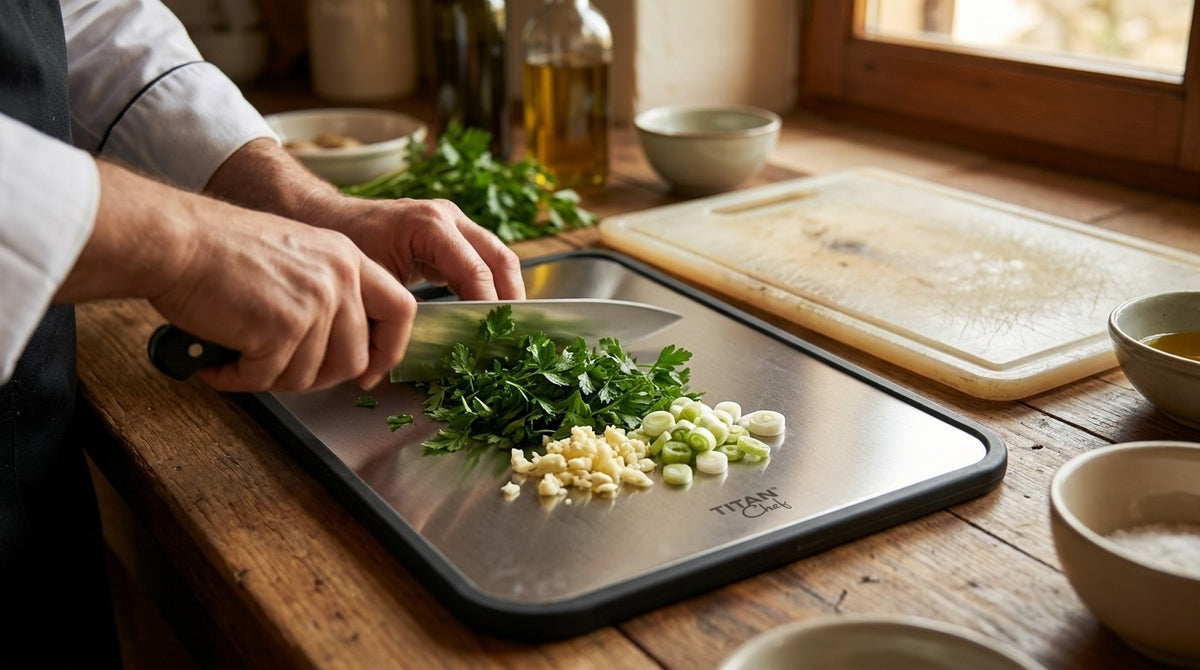
The most reliable materials for kitchenware are stainless steel, glass and ceramics. Stainless steel is non-porous and does not wear in a way that releases particles into food. A stainless steel cutting board does not release microplastics, does not need oiling, is dishwasher safe and keeps its properties for years. TitanChef stainless steel cutting boards are made of food-grade 304 stainless steel, a material that does not release chemicals into food. A direct and logical step for anyone who wants to be more mindful of plastic in the kitchen during pregnancy.
The same reasoning applies to kitchen utensils such as spatulas and spoons. Choose stainless steel or food-grade silicone instead of plastic versions, especially at high temperatures. Replace worn or scratched plastic kitchenware straight away: damaged plastic releases more particles than new material.
For a complete overview of which material works best in the kitchen, the comparison article on cutting board materials compared: plastic, wood, bamboo or stainless steel explains the pros and cons of each category.
In practice: how to reduce exposure step by step
The biggest gains come from the most frequent points of contact. These are the concrete steps that make the most difference:
- Replace the plastic cutting board with a stainless steel or glass one. This is the direct source of microplastics with every cut.
- Do not use plastic spatulas or spoons over high heat. Choose stainless steel or food-grade silicone.
- Never heat food in plastic containers, not even in the microwave. Use glass or ceramics.
- Throw away worn, scratched or discoloured plastic kitchenware. Damaged plastic releases more substances.
- Do not store food in plastic containers for long periods, especially not when it is warm or acidic, such as tomato or citrus.
- Warm breast milk in a glass bottle, not in a plastic bag or plastic baby bottle.
- Check whether plastic kitchenware carries a BPA-free label, keeping in mind that BPA-free does not automatically mean free of plasticisers.
Prevention is better than cure here. Not because science already knows everything about the long-term risks, but because the sources you can switch off yourself are simply not necessary. Replacing a plastic cutting board takes less than an evening of thought.
Looking for a cutting board without those drawbacks? Take a look at the TitanChef Original, made of solid stainless steel.
Also read: Are microplastics harmful to your health? What the research says.
Frequently asked questions about microplastics and pregnancy
Do microplastics from a plastic cutting board or plastic spoon end up in my food when I am pregnant?
Yes, this has been shown in several studies. Plastic cutting boards release microplastic particles into food during normal cutting, and plastic utensils such as spatulas and spoons do the same when heated. Research by Yadav et al. (2023) shows that a plastic cutting board can release up to 50 grams of microplastics per year into food with daily use. During pregnancy this is extra relevant, because those particles may reach the placenta via the bloodstream.
Can microplastics cross the placenta and reach my unborn baby?
Research shows that the placenta is not an impenetrable barrier. ZonMw researchers confirm that foreign compounds, including chemicals from plastics, can cross the placenta and reach the baby. A 2024 study by the University of New Mexico found microplastics in all 62 placentas tested. The exact consequences for the foetus are still the subject of ongoing research, but the presence of the particles is established.
What are the risks of BPA and plasticisers in plastic kitchenware during pregnancy?
BPA and related plasticisers are endocrine disruptors that can end up in food via plastic kitchenware, especially when heated. In 2023, the European Food Safety Authority (EFSA) lowered the tolerable daily intake of BPA by a factor of 20,000 and concluded that current exposure levels also pose a risk. Unborn children are particularly sensitive because their bodies are still developing. BPA can also pass from mother to child via the placenta and breastfeeding.
Is black plastic kitchenware extra dangerous when you are pregnant?
There are indications that black plastic kitchenware deserves extra attention. Scientific studies indicate that certain black plastics may contain harmful chemicals, including BPA, plasticisers and in some cases polycyclic aromatic hydrocarbons, which can be released when heated. Black plastic is sometimes made from recycled electronic waste, which makes its composition more unpredictable. During pregnancy it is wise to avoid black plastic kitchenware and choose materials whose composition is transparent and controlled.
Does using plastic spatulas over high heat increase the release of harmful substances?
Yes, temperature is one of the most important factors determining how many substances are released from plastic. A food safety expert at the Voedingscentrum confirms that the higher the temperature, the greater the chance that substances from the plastic end up in the food. When heated, molecules become more active, so unbound substances are released more easily. Some types of plastic are only suitable up to 70 degrees Celsius, while a pan on the hob easily reaches 150 to 200 degrees.
Are there also microplastics in breast milk?
Yes, research has found microplastics in breast milk. In an Italian study, microplastics were found in 75 percent of the samples tested. At the same time, researchers emphatically stress that breastfeeding remains the safest and most valuable form of nutrition for newborn babies: the benefits far outweigh the risks of the particles found. What you can do: do not warm breast milk in plastic bags or bottles, because heat significantly increases the release of microplastics.
Is heating plastic in the microwave dangerous for my baby?
Yes, using plastic in the microwave significantly increases the release of microplastics. Research showed that heating plastic food containers in the microwave for three minutes can release millions of microplastic particles per square centimetre. During pregnancy, the advice is never to reheat food in plastic containers, but in glass or ceramic dishes. This also applies to warming breast milk: do not do it in plastic bags or plastic baby bottles, but preferably in a glass bottle.
Which kitchenware is safe to use during pregnancy?
The most reliable choices are kitchenware made of stainless steel, glass or ceramics. These materials do not release microplastics, BPA or plasticisers into food. A stainless steel cutting board is non-porous and does not wear in a way that releases particles into food. The same principle applies to cookware: stainless steel, cast iron and glass are safe alternatives to plastic spatulas, spoons and containers. Worn or scratched plastic kitchenware deserves immediate replacement in any case, because damaged plastic releases more particles.
How can I reduce my exposure to microplastics in the kitchen while pregnant?
The most effective steps are: replace plastic cutting boards and plastic kitchenware with stainless steel, glass or ceramics; never heat food in plastic containers, not even in the microwave; throw away worn or scratched plastic kitchenware; and do not store food in plastic containers for long periods, especially not when warm. A plastic cutting board is one of the easiest sources of microplastics in the kitchen to replace. It takes little effort and has a direct effect on the amount of plastic that ends up in your food.


