



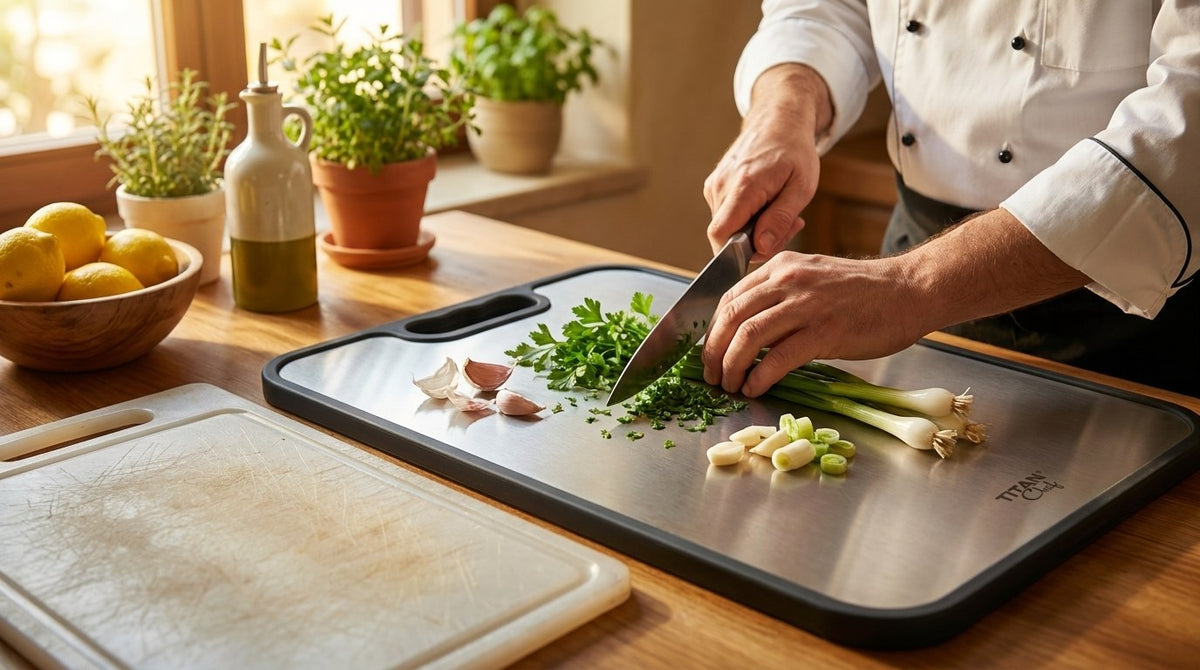
Every evening you cut vegetables on the same plastic cutting board, stir the pan with a plastic spatula and do not think about it any further. That is exactly how most households cook. But research is making it increasingly clear that using a plastic cutting board every day, especially in combination with other plastic kitchen utensils, is not a neutral habit. Small plastic particles come loose with every cut and every stir in a hot pan, and end up in the food you eat afterwards.
This article discusses exactly what happens during cooking, what those particles do once they are in your body, and why the combination of a plastic cutting board plus plastic kitchen utensils has a bigger effect than either one on its own. At the end you will find an FAQ with the most frequently asked questions on this topic.
How daily use of a plastic cutting board turns into food contamination
A plastic cutting board wears with use. That is not a design flaw, it is a property of the material. Every time a knife crosses the surface, it removes tiny pieces of polypropylene or polyethylene. Research by Yadav et al. (2023), published in Environmental Science and Technology, calculated that a polypropylene board can release up to about 50 grams of microplastics per person per year with normal use. Up to 15 microplastic particles are released with every cut, depending on the hardness of the ingredient and the cutting style.
The researchers literally call the plastic cutting board an "overlooked source" of microplastic exposure. Not because it is the only source, but because people rarely associate the cutting board with ingesting plastic, even though they prepare food directly on it every day.
The particles released stick to moist ingredients such as raw meat, fish, vegetables and herbs. They then end up on the plate and in the stomach. It is not a reassuring thought, but it is not a moment for panic either. What it is: a reason to look at which sources in your own kitchen you can control.
Plastic kitchen utensils and heat: microplastics released in the pan
The plastic cutting board is not the only source. If you stir a hot pan with a plastic spatula every day, you add a second moment of exposure to the same meal. Heat significantly speeds up the breakdown of plastic material. Research in Science of the Total Environment (Cole et al., 2024) showed that plastic kitchen utensils release microplastics with daily use, with estimates of two thousand to almost five thousand microplastic particles per year ending up in home-cooked meals this way.
Heat makes plastic more brittle, so it wears and flakes faster. Repeated use and the dishwasher speed up that process further. A black plastic spatula that has been around for a few years and shows fine cracks releases more particles with every hot meal than a new one. A 2024 study published in Chemosphere (Liu et al.) also found that black plastic kitchen utensils are in many cases made from recycled electronics plastic, including the flame retardants it contains. Those substances do not belong in your food.
In everyday practice, the combination of a plastic cutting board and plastic kitchen utensils means there is a plastic source at almost every step of food preparation: cutting, stirring, serving. The exposure builds up, without you seeing or tasting it.
What makes a scratched cutting board extra risky
A frequently asked question is whether a scratched plastic cutting board is more dangerous than a new one. The answer is yes, and the difference is not small. Every scratch a knife leaves in the surface increases the total contact surface of the plastic. The more scratches, the more loose particles are released with every cut.
On top of that comes a second problem: those scratches and grooves are hard to clean. Bacteria settle in the grooves and cannot be completely removed by rinsing or even the dishwasher. A scratched plastic cutting board therefore combines two risks at once: increased release of microplastics and an increased hygiene risk from bacteria left behind. Read more about that second risk in the blog about plastic cutting board scratches, bacteria and microplastics: what is in those grooves after a year.
When a plastic cutting board needs replacing is a logical question that follows from this. The practical limit is hard to pin down, but deep scratches and discolouration are clear signs that the material is breaking down faster. Read more about the signs in the blog about when to replace your cutting board and how to recognise the signs.
What happens to microplastics once they are in your body
Microplastic particles ingested through food are small enough to pass through the intestinal wall and enter the bloodstream. Scientists now find them in human blood, lung tissue, the placenta of pregnant women and, as research by Nihart et al. (2025) showed, even in brain tissue. In that last study, three to five times as many plastic fragments were found in the brains of people with dementia as in healthy controls. That does not prove a causal link, but it is a finding that is taken seriously in scientific circles.
A clinical study in the New England Journal of Medicine (Marfella et al., 2024) followed patients in whom microplastics were found in the plaque in their carotid arteries. These patients had a significantly higher risk of heart attack, stroke and death than patients in whom no microplastics were found in the artery wall. This is the first study to show a direct link between microplastics in the human body and a serious clinical health outcome.
In animal research, long-term exposure to microplastics has also been linked to inflammatory responses in the gut and shifts in the gut flora. Research published in Environmental Health Perspectives (2025) gave mice amounts of microplastics corresponding to what a plastic cutting board releases, and then recorded measurable intestinal inflammation and changes in the composition of the gut flora. These are results from animal research, with all the caveats that come with it, but they point in a direction that researchers take seriously.
Hormone disruption: the second layer of the plastic problem
Plastic contains more than just the base material. During production all kinds of additives are added, such as phthalates, bisphenol A and plasticisers. These substances are classified as hormone-disrupting chemicals, also known as endocrine disruptors. They can mimic or block hormone activity in the body, even at relatively low concentrations.
A review published in The Lancet Diabetes and Endocrinology (2026) describes how micro- and nanoplastics disrupt internal hormonal signalling pathways and can affect the functioning of the thyroid, ovaries and pancreas. The review stresses that pregnant women and children are particularly vulnerable, because hormonal development in those phases is more sensitive to external disruption. This is not a finished scientific story, but it is one that is growing quickly in scope and seriousness.
Plastic kitchen utensils used every day to prepare hot meals contribute to exposure to these substances. That applies to the cutting board when cutting, but also to spatulas, stirring spoons and baking moulds that come into contact with hot dishes. Heat promotes the migration of additives from the plastic into the food.
Replacing your everyday plastic cutting board: what works and what does not
The question that follows is practical: what are the alternatives, and do they really work? For the cutting board, two materials stand out among scientists and cooks as the better choice: hardwood and stainless steel. Hardwood is kinder to knives than stainless steel, but porous by nature. Bacteria and moisture can soak into the fibres, and the board needs regular maintenance.
Stainless steel is non-porous. No scratches form that release microplastics, because the material is metal and does not wear that way. A stainless steel cutting board releases nothing into food, is hygienic because bacteria cannot settle into the smooth surface, and can simply be cleaned in the dishwasher. Research confirms that using non-plastic kitchen utensils directly eliminates the introduction of microplastics into home-cooked meals: a study in Science of the Total Environment (2024) found that using non-plastic cookware added no measurable microplastic contamination to the food simulant.
The same logic applies to kitchen utensils: stainless steel spatulas and wooden or silicone stirring spoons are direct replacements for plastic ones. They do not heat up in a way that causes breakdown, and they do not release additives into what you cook. Switching to plastic-free cooking does not require a complete kitchen makeover. It starts with the tools that come into contact with food the most every day: the cutting board and the stirring utensils.
The TitanChef stainless steel cutting board is made of food-grade 304 stainless steel, has a brushed surface and both sides are usable. For anyone who regularly works with juicy ingredients, the TitanChef PRO offers a non-slip rubber edge and a raised rim that keeps juices on the board while you cut. Dishwasher safe, no maintenance, no microplastics.
Looking for a cutting board without those drawbacks? Take a look at the TitanChef Original, made of solid stainless steel.
Also read: Plastic-free cutting board: keep microplastics out of your food.
Frequently asked questions about microplastics from daily plastic cutting board use and plastic kitchen utensils
How many microplastics do I take in if I cut on a plastic cutting board every day?
Research by Yadav et al. (2023), published in Environmental Science and Technology, calculated that a polypropylene cutting board can release up to about 50 grams of microplastics per person per year with normal daily use. Up to 15 microplastic particles come loose with every cut, depending on the material of the board and the hardness of the ingredient. That is a considerable amount for something that feels as natural as cutting vegetables.
Are microplastics from plastic kitchen utensils harmful to your health?
Research shows that microplastics from plastic kitchen utensils end up directly in food, both through wear during cutting and through heat acting on plastic spatulas and stirring spoons in a hot pan. The exact long-term health damage is still being researched extensively. What scientists have already established: microplastics have been found in human blood, lung tissue, the placenta and brain tissue, and a clinical study in the New England Journal of Medicine (Marfella et al., 2024) linked the presence of microplastics in the artery wall to an increased risk of heart attack and stroke.
What happens to microplastics once they are in your body?
Once ingested, microplastics can be absorbed through the intestinal wall and the bloodstream and end up in various organs. Researchers now find them in human blood, lung tissue, the placenta of pregnant women and, as a 2025 study showed, even in brain tissue. The body has no mechanism to break down plastic or easily excrete it. Long-term accumulation and the associated inflammatory responses are the subject of active ongoing scientific research.
Is a scratched plastic cutting board more dangerous than a new one?
Yes, a scratched plastic cutting board releases more microplastics than a new one. The scratches and grooves caused by knife use enlarge the contact surface and constantly supply loose particles. Those grooves are also hard to clean completely, so they become a breeding ground for bacteria too. The deeper the scratches, the higher the release of microplastic particles with every following cut.
Does a plastic spatula or stirring spoon also release microplastics when I stir a hot pan?
Yes, heat significantly speeds up the release of microplastics from plastic kitchen utensils. Research published in Science of the Total Environment (2024) showed that plastic kitchen utensils can contribute thousands to almost five thousand microplastic particles per year to home-cooked meals with daily use. Heat makes the plastic break down faster, flake and release small particles into what you cook. With black plastic kitchen utensils there is also a risk of other harmful substances carried over during production.
Do microplastics from plastic kitchen items disrupt my hormones?
Plastic contains additives such as phthalates and bisphenol A, which are classified as endocrine disruptors. A review published in The Lancet Diabetes and Endocrinology (2026) states that micro- and nanoplastics can mimic hormone activity and disrupt internal hormonal signalling pathways. Scientific research points to possible effects on the thyroid, reproductive organs and metabolism, although the exact thresholds in humans are still being studied. Children and pregnant women are considered particularly vulnerable.
Is the effect worse if you use both a plastic cutting board and plastic kitchen utensils?
Every plastic source in the kitchen contributes to total daily exposure to microplastics. A plastic cutting board together with plastic spatulas or stirring spoons means several moments of exposure per meal in practice: cutting adds particles to the ingredients, stirring in a hot pan adds particles to the cooked meal. The amounts add up over the day and over the years. Removing both sources at once therefore has more effect than replacing just one.
What is a safe alternative to both plastic cutting boards and plastic kitchen utensils?
For the cutting board, stainless steel and hardwood are the most frequently mentioned alternatives. A stainless steel cutting board is non-porous, does not release microplastics and is simply dishwasher safe. For kitchen utensils, stainless steel spatulas, wooden stirring spoons or silicone spatulas are good replacements for plastic ones. Replacing both at once is a direct and simple way to sharply reduce daily plastic intake through home-cooked meals.
Conclusion
If you cook every day with a plastic cutting board and plastic kitchen utensils, you take in microplastics via two routes at once: through wear on the cutting board and through heat acting on plastic spatulas and stirring spoons. These are not dramatic amounts per meal, but they add up over months and years. Science is beginning to map the consequences: from intestinal inflammation to indications of hormone disruption and increased cardiovascular risk in people with microplastics in their artery wall. The exact thresholds have not yet been established, but the direction of the research is consistent. Replacing your plastic cutting board and plastic kitchen utensils with materials such as stainless steel is one of the most direct steps you can take in your own kitchen.
Below you will find the TitanChef stainless steel cutting boards, and more blogs if you want to read further on this topic.


