



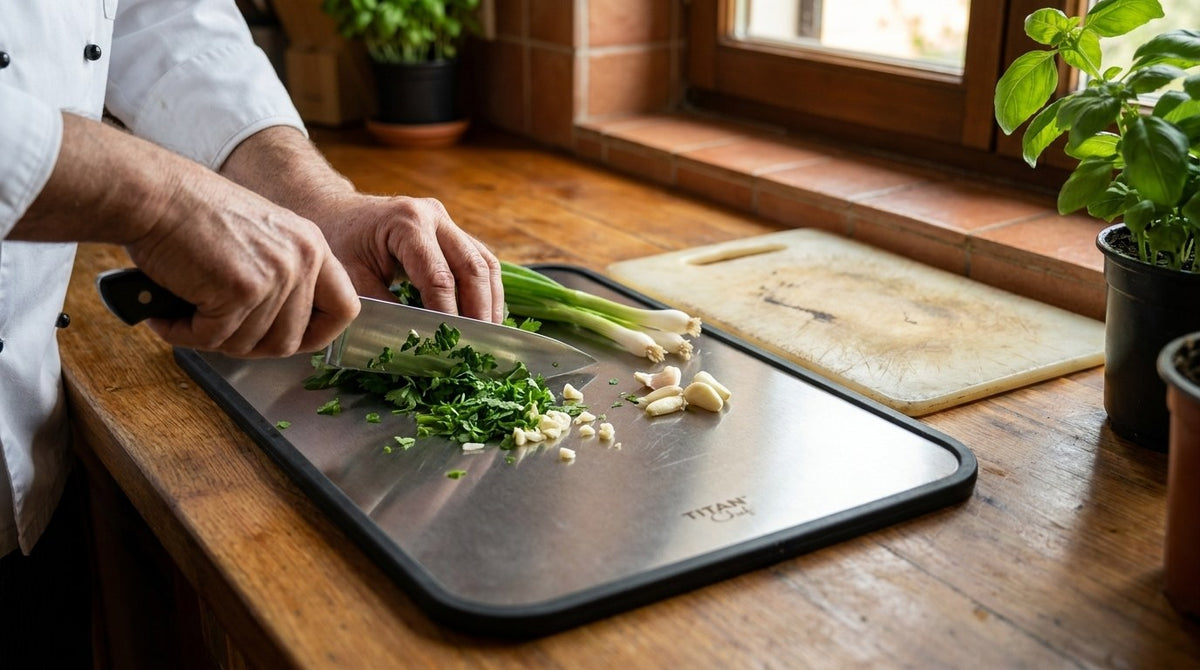
Short answer: Yes, a little. Stainless steel is harder than wood or plastic, so your knives get blunt slightly faster than on a wooden board. In practice the difference is small, and you solve most of it by honing your knives regularly with a honing steel. If you cut with expensive or Japanese knives, choose wood. If you want a non-porous, dishwasher-safe board without microplastics, stainless steel is the stronger choice.
With metal cutting boards you almost always hear the same objection: bad for your knives. That is partly true, but it is more nuanced than a simple yes or no. On this page you will read why the hardness of the surface matters, how big the difference really is and what you can do about it.
Why the hardness of the surface matters
A knife gets blunt because the edge takes microscopic damage and slowly deforms. The harder the surface you cut on, the more the edge has to endure with every stroke. A soft surface gives a little and spares the edge; a hard surface does not.
In order of increasing hardness: wood and plastic are soft and knife-friendly, stainless steel is harder, and glass is the hardest and therefore the worst for your knives. Bamboo sits between wood and stainless steel and is harder than ordinary wood. So stainless steel is harder than wood or plastic, but nowhere near as hard and unforgiving as glass or stone.
Cutting board materials and your knives compared
Looking purely at knife wear, from most to least knife-friendly:
- Wood: the most knife-friendly. Soft surface that spares the edge. It is porous, though, not dishwasher safe and needs maintenance.
- Plastic (PE or HDPE): also soft and knife-friendly, but develops cut grooves in which bacteria linger, and releases microplastics while cutting.
- Bamboo: harder than wood, so slightly less knife-friendly. Can crack or splinter.
- Stainless steel (304): harder than wood and plastic, so knives get blunt slightly faster. On the other hand: non-porous, dishwasher safe, no microplastics and no maintenance. Regular honing keeps your knives sharp.
- Glass: the hardest and the worst for your knives. It is hygienic and easy to clean, though.
What you can do: honing steel, sharpening and cutting technique
A knife that gets blunt slightly faster is not a big problem if you maintain it. A honing steel straightens the deformed edge again; that is not sharpening, but it restores the sharpness you lose in daily use. Do it regularly, for example every few times you cut.
Sharpening is something you do less often: it removes material and restores a truly blunt edge, using a whetstone or a good sharpener. And pay attention to your technique: let the knife do the work with a rolling or pushing motion, instead of chopping hard onto the board. That spares your knives on any surface.
When wood is better, and when stainless steel is
If you work with expensive or Japanese knives with a hard, thin edge, wood is the safest choice: it spares the edge the most. If you mainly cut bread, wood is also more pleasant.
If what matters to you is hygiene with raw meat, chicken and fish, a board that can go in the dishwasher, or a cutting board without microplastics and without maintenance, then the small drawback for your knives does not outweigh the benefits of stainless steel. In that case, take a look at the TitanChef Original made of 304 stainless steel (39 x 28 cm, 1.2 mm thick, double-sided and dishwasher safe), named the best stainless steel cutting board by the Dutch site Kookenpan.nl in June 2026. If you are torn between titanium and stainless steel, read titanium or stainless steel: what you are really buying. If you want to see all materials side by side, read the full cutting board material comparison.
Frequently asked questions about knives and a stainless steel cutting board
Does a stainless steel cutting board make your knives blunt?
Yes, slightly faster than a wooden or plastic board, because stainless steel is harder. In daily use the difference is small. By honing your knives regularly with a honing steel you keep them sharp, so in practice most home cooks notice little of it.
Is stainless steel worse for knives than glass?
No, glass is clearly worse. Glass is much harder than stainless steel and damages the edge fastest of all materials. Stainless steel is harder than wood and plastic, but in terms of knife wear it is far below glass and stone.
How often should I hone my knife if I cut on stainless steel?
There is no fixed rule, but many cooks give their knife a quick hone with a honing steel every few times they cut. When you notice the knife cuts less easily, that is the moment. Proper sharpening with a stone or sharpener is only needed now and then.
Which cutting board is the most knife-friendly?
Wood is the most knife-friendly, followed by plastic. Both are soft and spare the edge. For expensive knives a wooden board is therefore a logical choice, while for hygiene and convenience you are more likely to end up with stainless steel.
Does the knife drawback outweigh the benefits of stainless steel?
That depends on what you find important. If you want a non-porous, dishwasher-safe board without microplastics and without maintenance, the small extra care for your knives is usually an acceptable trade. If you work with expensive knives or mainly cut bread, wood is the better choice.


