



In professional kitchens, people have been thinking for years about which material lies on the worktop. Not for aesthetic reasons, but for food safety. The result is a strict system of colour-coded cutting boards, strict replacement routines and clear hygiene codes. The ordinary plastic cutting board from the supermarket stopped fitting in there long ago. The question is: why does the average home cook not know this yet? The answer has everything to do with plastic cutting board microplastics and the growth of scientific research into them.
What happens when your knife hits a plastic cutting board
Every time a knife passes over a plastic cutting board, a small amount of material wears off. That is not something you see or smell. It involves microscopically small particles, smaller than five millimetres and in many cases smaller than a hundred micrometres, invisible to the naked eye. Yet they are measurably present on the food you prepare.
Research by North Dakota State University, published in the scientific journal Environmental Science and Technology (Yadav et al., 2023), examined exactly how many particles are released when cutting vegetables on polyethylene and polypropylene boards. The outcome was striking: with daily use, a plastic cutting board can release between 7.4 and 50.7 grams of microplastics per year into food. Polypropylene boards released up to 71 percent more particles than polyethylene boards. The researchers explicitly describe the cutting board as an "overlooked source" of microplastic intake through food.
A follow-up study from 2025, published in the scientific journal Environmental Health Perspectives, gave mice the amounts of microplastics released during normal cutting board use. After longer-term exposure, inflammatory reactions in the gut and shifts in the gut flora were observed. It is the first study to link a direct biological effect to microplastics coming specifically from cutting boards.
You can read more background on the health risks of microplastics in the blog about microplastics and long-term health risks: what does the research say.
How professional kitchens tackle it: the HACCP colour-code system
Professional kitchens are required to work according to the HACCP system, which stands for Hazard Analysis and Critical Control Points. This is a food safety system prescribed by European law that applies to every business that produces or processes food. In the Netherlands, for example, the food safety authority NVWA monitors compliance.
One of the most visible applications of that system is the HACCP cutting board colour code. Each colour stands for a specific type of food, so that cross-contamination is structurally prevented. The usual system works as follows:
- Red: raw red meat
- Yellow: raw poultry, such as chicken and turkey
- Blue: raw fish and seafood
- Green: fruit and vegetables
- White: bread, cheese and dairy products
- Brown: cooked meat
In professional kitchens, the boards themselves are made of heavy-duty HDPE plastic: High Density Polyethylene, a material that is non-absorbent, resistant to high temperatures and easy to clean in a commercial dishwasher. That is a different material from the thin, cheap boards found in most home kitchens. But HDPE boards wear too. That is exactly why professional kitchens apply strict replacement routines: boards are replaced at fixed moments, not only once they are visibly damaged.
The reasoning behind this is simple: a damaged board with deep scratches is a hygiene risk, because bacteria settle in the grooves and are harder to remove. Those same scratches are also exactly where most microplastics come from.
What home cooks do differently and what that means
The home kitchen lacks the protocols of professional kitchens. There is no fixed replacement routine, no colour-code chart on the wall and often no awareness of when a board has reached the end of its life. The average plastic cutting board lasts for years, long past the point at which the surface is still smooth. Deep scratches and discolouration are seen as normal rather than as a signal that the board needs replacing.
That has two concrete consequences. First, bacteria settle in plastic cutting board scratches more easily than on a smooth surface, especially if the board is not cleaned thoroughly enough after contact with raw meat. Second, microplastic release increases as the surface gets more damaged: every new knife contact over an already damaged surface releases more particles than on a surface that is still intact.
At the same time, the home cook is not bound by the conditions of a professional kitchen. A restaurant works with dozens of cuts per hour, switches boards in between and has a set washing routine. At home the intensity is lower, but so is the awareness of when the board really needs replacing.
You can read more about what eventually ends up in the grooves of a used plastic board in the blog about plastic cutting board scratches, bacteria and microplastics: what is in those grooves after a year.
Plastic cutting board microplastics and what science says about health
The health science around microplastics is still in full swing. What researchers now know is that microplastics are found in human blood, in placental tissue of pregnant women, in lung tissue and in arterial plaque. The particles accumulate in the body, because the body cannot easily process or excrete them.
A clinical study published in the New England Journal of Medicine (Marfella et al., 2024) followed patients who underwent a procedure to remove plaque from the carotid artery. Patients in whom microplastics were found in the plaque had a significantly higher risk of heart attack, stroke or death in the following three years than patients without microplastics in the tissue. It is the first clinical study to make a direct link between microplastics in the body and a serious health effect in humans.
That does not mean a plastic cutting board leads directly to cardiovascular problems. Science is honest about this: causality has not yet been fully demonstrated, and the exact dose at which harm occurs in humans is the subject of ongoing research. But the direction of the findings is clear enough to take sources you can switch off yourself seriously. And a cutting board is one of the easiest sources in the kitchen to replace.
What professional kitchen logic teaches: when do you replace a cutting board?
Professional kitchens replace boards based on condition and schedule, not on "it still works". That is a useful basic rule for the home kitchen. A few concrete signs that a plastic cutting board needs replacing:
- Visible, deep scratches across the whole surface
- Discolouration that no longer comes off after washing
- A board that has been used intensively for more than two to three years
- A smell that lingers, even after thorough cleaning
- A surface that feels rough to the touch
In professional kitchens, boards are even replaced before they get that far. For the home cook that is less realistic, but the rule that a damaged board is a problem and no longer a tool applies at home too.
Preventing plastic cutting board microplastics: what are the alternatives?
If you are looking for a cutting board without microplastics, you will logically look at materials that do not wear the way plastic does. Wood and bamboo do not release microplastics, but they need maintenance: regular oiling, no dishwasher, sensitive to moisture and cracking. Bamboo is also often glued, which makes it more vulnerable when damaged.
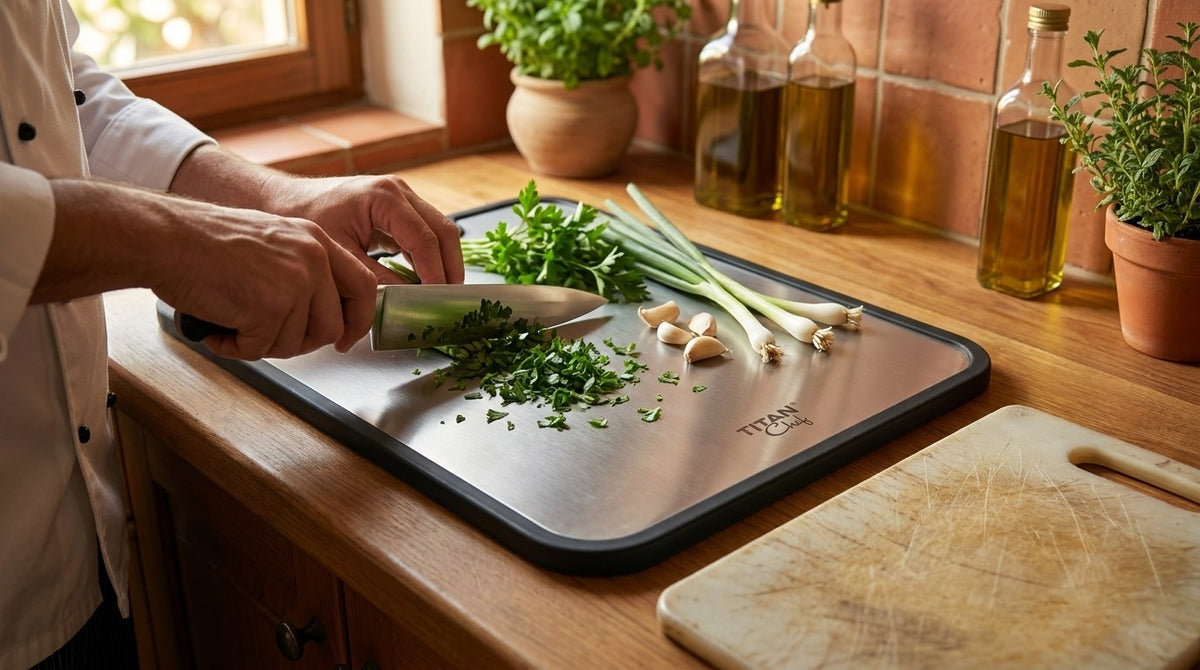
Stainless steel solves both problems. The surface is non-porous, no particles come loose during cutting, and a stainless steel cutting board simply goes in the dishwasher. The TitanChef stainless steel cutting board is made of food-grade 304 stainless steel, with a brushed surface that can be used on both the front and the back. Those two sides are practical: raw fish or meat on one side, vegetables on the other, without needing a second board.
It is not a specialist product for professional kitchens. The TitanChef stainless steel cutting board is designed for the home cook who cooks every day and does not want microplastics in their food, without use or cleaning taking any extra effort. Keeping your cutting board microplastic-free does not have to be complicated: it starts with the choice of material.
What home cooks can take from the professional kitchen approach
Professional kitchens solve the problem systematically: colour codes, fixed replacement routines and a conscious choice of material. At home you do not need those systems on the same scale, but the underlying logic works on a smaller scale too.
In practical terms, that means the following:
- Judge your cutting board on condition, not age. A heavily scratched plastic board is a problem, no matter how old it is.
- Keep raw meat and vegetables separate, at home too. Two sides of one board or two separate boards.
- Reconsider the material if you need to replace your board anyway. A plastic-free board solves the microplastic problem structurally, not temporarily.
- A dishwasher-safe board makes hygienic cleaning easier. That is also an argument professional kitchens know well.
Professional kitchens have not developed strict protocols around cutting boards for nothing. The insights behind them are also useful in the home kitchen. You do not need to set up a HACCP system for it.
Looking for a cutting board without plastic? The TitanChef Original is made of 304 stainless steel and does not release microplastics.
Want to know more? Also read a cutting board without plastic: how to avoid microplastics in your food.
Frequently asked questions about plastic cutting board microplastics
How many microplastics are released when cutting on a plastic cutting board?
Research by North Dakota State University, published in Environmental Science and Technology (2023), shows that with daily use plastic cutting boards can release between 7.4 and 50.7 grams of microplastics per year into food. Polypropylene boards release 14 to 71 percent more particles than polyethylene boards. Most of the released particles are smaller than 100 micrometres and therefore completely invisible to the naked eye.
Why do restaurants no longer use ordinary plastic cutting boards?
Professional kitchens in the EU are required to work according to the HACCP system, which stands for Hazard Analysis and Critical Control Points. This system requires colour-coded cutting boards to prevent cross-contamination: red for raw meat, yellow for poultry, blue for fish, green for vegetables and white for bread and dairy. Those boards are made of heavy-duty HDPE plastic and are replaced at fixed moments after intensive use. A board that is visibly damaged is no longer used in a professional kitchen.
Is a wooden cutting board more hygienic than a plastic cutting board?
Wood does not release microplastics, which is a clear advantage over plastic. Scientific research has also shown that wood naturally has certain antibacterial properties. The drawback is that wood is porous: moisture, odours and bacteria can penetrate deeper into the fibres, especially after intensive use or if the board is poorly maintained. A wooden cutting board needs regular oiling, cannot go in the dishwasher and can warp or crack with prolonged use. For anyone who wants no microplastics and no extensive maintenance routine, a non-porous option such as stainless steel is more practical.
What is the best cutting board if you do not want to ingest microplastics?
The most direct solution is a cutting board without microplastics: a material that does not wear under the knife and does not release particles into food. Stainless steel (304) meets that requirement. The surface is non-porous, does not wear in a way that produces microplastics and is easy to clean in the dishwasher. The TitanChef stainless steel cutting board is a logical choice for that reason for the home cook who wants a microplastic-free cutting board: brushed 304 stainless steel, usable on both sides and fully dishwasher safe.
Does a stainless steel cutting board make your knives blunt faster?
Stainless steel is harder than plastic or wood, so the edge of a knife meets a little more resistance than on a soft surface. In practice this is fine for home use, especially if you use knives of decent quality. Many cooks also see light wear on the edge as a normal consequence of use, not as a problem with the material. You can read more about this in the blog about stainless steel cutting boards and knives: what is true and is it worth it.
Which cutting board can go in the dishwasher?
A stainless steel cutting board is fully dishwasher safe: resistant to high temperatures, detergent and repeated wash cycles. Wooden and bamboo cutting boards cannot go in the dishwasher, because they can warp, crack or split. Technically, plastic cutting boards can go in the dishwasher, but the hot water and mechanical stress actually speed up surface breakdown, so even more microplastics come loose the next time you use them.
How do you know when your plastic cutting board needs replacing?
The most visible sign is a surface full of deep scratches and grooves. Bacteria settle more easily in those grooves, and at the same time microplastic release increases as the board gets more damaged. In professional kitchens, the rule of thumb is that boards are replaced before they are visibly damaged. At home, a heavily scratched plastic cutting board concretely means: replace it. A stainless steel board does not have this problem, because the surface does not wear in a way that leads to grooves or particle release.
Is bamboo a safe alternative to plastic cutting boards?
Bamboo does not release microplastics the way plastic does, which is an advantage. Yet bamboo has drawbacks that make it less straightforward in practice: the material is prone to cracking with intensive use or a lot of contact with moisture, and bamboo products are often glued, which can speed up moisture absorption when damaged. Like wood, a bamboo cutting board cannot go in the dishwasher and needs maintenance. For anyone who really wants to go plastic-free without a maintenance routine, stainless steel is a more practical choice.
Conclusion
Professional kitchens have been working for years with protocols that the home kitchen hardly knows. The core of that approach is simple: use materials that are easy to keep clean, replace them in time and make sure cross-contamination is structurally prevented. That plastic cutting boards release microplastics with daily use is now scientifically supported. It is not an alarming conclusion, but it is a reason to take the choice of material seriously. A cutting board is one of the easiest things in your kitchen to replace.


