



Did you know that a baby can come into contact with microplastics even before birth, via the mother's placenta? And that after birth the kitchen is one of the most direct sources? The discussion about microplastics often focuses on adults, but for babies and toddlers the situation is more worrying. Their bodies are still developing, and that makes them extra vulnerable to substances that may have less impact on an adult.
In this article you will read what recent scientific studies say about the link between microplastics, the baby immune system and early development. And what you as a parent can do in the kitchen to limit your child's exposure.
Why the link between microplastics and the baby immune system matters so much
A baby's immune system is far from mature at birth. In the first years of life it learns who is friend and who is foe, it builds tolerance, and it develops the ability to fight infections and inflammation. Exactly in that sensitive period, exposure to microplastics is also at its highest.
Scientific review research confirms that children are extra vulnerable to the adverse effects of environmental pollution such as microplastics precisely because of this immature immune system (Nadarasan et al., 2025, published in Toxicology Reports). A 2024 study published in Science of the Total Environment shows that exposure to microplastics during the nursing period can change the immune status of both mother animals and their offspring. These are findings in animals, but they give scientists reason to pay extra attention to the early stage of life.
Research within the AURORA project looked at samples of placentas and umbilical cord blood from 800 newborns and found a link between internal exposure to microplastics and blood biomarkers indicating activation of the immune system. These are early signals, not definitive proof of harm. But they are signals that are taken seriously by scientists studying the early years of life.
How microplastics reach babies: several routes at once
For an adult, exposure routes run through food, drinking water and air. For a baby or toddler, specific routes are added that considerably increase total intake.
Through the placenta, even before birth
A 2024 systematic review, published in PubMed Central, confirms the presence of microplastics measuring 2.1 to 100 micrometres in both the placenta and the foetal body. Microplastics have also been found in amniotic fluid, meconium and umbilical cord blood. So exposure begins before the very first spoonful of baby food.
Through formula feeding and plastic baby bottles
Researchers at the University of Dublin (published in Nature Food) showed that polypropylene baby bottles can release up to 16 million microplastic particles per litre when heated and shaken. On average, babies are estimated to take in 1.58 million particles per day via this route. That is many times what adults take in daily through regular food and drink.
Heating and sterilising the bottle are the biggest causes of that release. The higher the temperature and the more mechanical movement, the more particles are released. The Voedingscentrum, the Netherlands Nutrition Centre, stresses that there is not yet enough evidence to conclude whether this is harmful in the short or long term, but the numbers are large enough to take precautions seriously.
Through breast milk
Breast milk is and remains the best food for a baby. But microplastics have been found in it as well. A study published in the Journal of Clinical Medicine (2024) confirms the presence of microplastics in breast milk and sees a link with changes in the bacterial population of the milk. This shows how widespread microplastic pollution already is. Stopping breastfeeding because of microplastics makes no sense: the benefits far outweigh the risks.
Through the kitchen: cutting board, utensils and preparation
While you prepare baby food, the cutting board also plays a role. Research by Yadav et al. (2023, Environmental Science and Technology) shows that a plastic cutting board can release up to 50 grams of microplastics per year with normal use, directly into the food prepared on it. Every time you cut a carrot or a piece of fruit for your child, up to 15 microplastic particles can be released per cut. Those particles are smaller than 100 micrometres and can be neither seen nor felt, but they are there.
For more background on how microplastics from plastic kitchenware end up in your food, also read: Top 10 items in your kitchen that spread microplastics.
What microplastics do to the still-developing immune system
Science is cautious in its conclusions, but the direction of the research is clear. Microplastics are not an inert material that simply passes through the body. They bind to proteins, they disrupt cell processes, and they can affect the intestinal wall.
Disruption of gut flora and immune development
The gut plays a central role in the immune development of babies. A healthy gut flora in the first years of life lays the foundation for a well-functioning immune system later on. Research published in the Journal of Neonatology (2025) shows that microplastics and nanoplastics can disrupt the development of the gut flora in infants. They can slow down the stabilisation of the microbiome and also promote antibiotic resistance through bacterial biofilm transport. Both are effects that hit particularly hard in the early stage of life.
A 2025 study (published in PubMed, Polystyrene Microplastics Disrupt Vertical Transmission of the Breast Milk Microbiome) shows that exposure to polystyrene microplastics disrupts the bacterial composition of breast milk, resulting in limited transfer of gut bacteria to the child and weakened immune development in the offspring.
Activation of inflammatory pathways
Studies in cell models show that microplastics bind proteins involved in immune and inflammatory responses. The first studies using intestinal epithelium models from human stem cells show that microplastics can disrupt the intestinal barrier. For a baby, whose intestinal barrier is still being built and whose immune system is still learning to regulate itself, these are mechanisms that deserve extra attention.
Research within the IMPTOX and AURORA projects looks specifically at immune responses and health in the early years of life, including asthma and allergies. The Dutch National Institute for Public Health and the Environment (RIVM) is continuously researching the effects on the immune system through the ZonMw Microplastics and Health programme. The RIVM's message is consistent: the long-term consequences are still uncertain, but that is a reason for caution, not for waiting.
Additives in plastic: a second problem alongside the particles themselves
Besides the physical particles, many plastics contain chemical additives such as plasticisers, BPA variants and other substances that can have endocrine-disrupting effects. A baby's hormone system is particularly sensitive to this kind of disruption in the first years of life. This is a separate but related risk that gives concerns about plastic kitchenware in a family with young children extra urgency. Read more about this in the blog about BPA-free plastic and alternatives such as BPS and BPF.
What you can do to limit microplastics in baby food from the kitchen
Eliminating microplastics completely is not realistic. They are in air, water and virtually all food chains. But there are sources you control yourself, and the kitchen is one of them. Small choices make a measurable difference here.
Replace the plastic cutting board
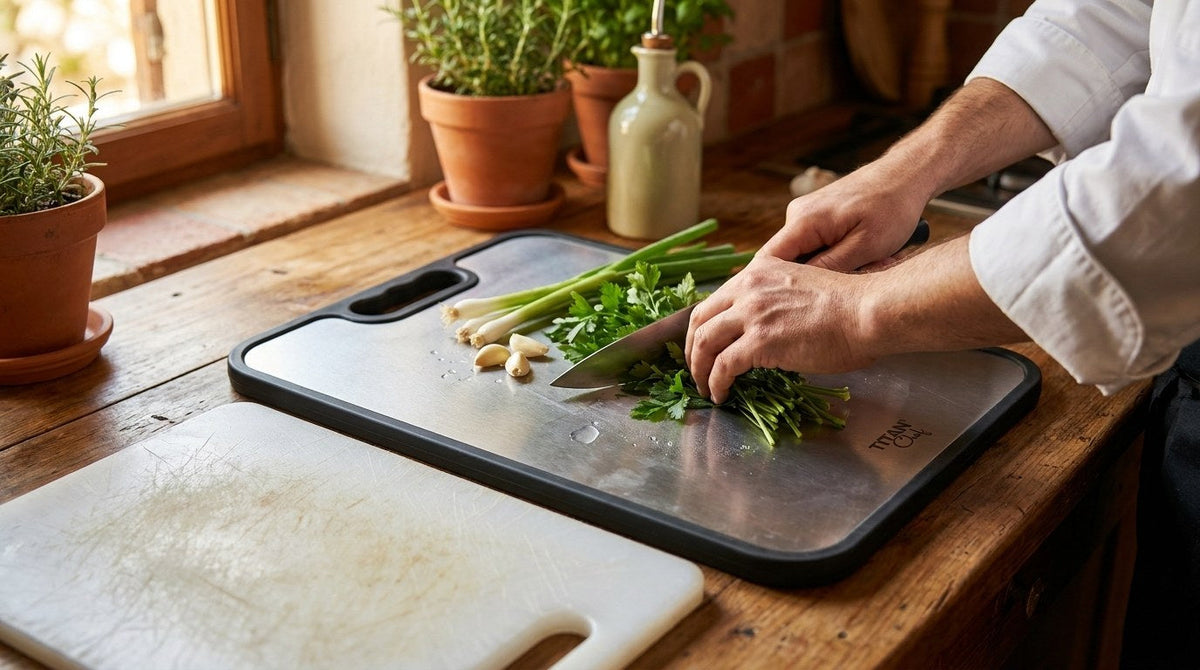
The plastic cutting board is one of the easiest sources of microplastics in the kitchen to replace. A stainless steel cutting board does not release microplastics during use: the surface does not wear the way plastic does. That means the vegetables, fruit and meat you prepare on that board for your child stay free of wear particles. The TitanChef stainless steel cutting board is made of 304 food-grade stainless steel, goes in the dishwasher and does not need oiling. Switching could not be simpler.
Do not warm formula in plastic
Preferably prepare formula in a glass or steel pan or bowl, and let it cool before you pour it into the bottle. Do not shake the bottle vigorously: that also increases the release of microplastics. Consider glass baby bottles as an alternative to plastic. The Irish researchers who carried out the baby bottle study give parents exactly this advice.
Avoid reheating in plastic containers
Plastic and heat are not a good combination. At higher temperatures plastic becomes more flexible and its molecular structure breaks down faster. So never reheat baby food in a plastic container or in the microwave in plastic packaging. Choose glass or stainless steel for reheating and storing your child's meals.
Swap plastic spatulas and spoons
Plastic spatulas and ladles wear when in contact with hot pans. At temperatures above 70 degrees Celsius, particles are released faster. Replace them with wooden or stainless steel ones. That is a small investment with a direct effect on what ends up in the pan, and ultimately on your child's plate.
Store food in glass
Use glass storage containers for leftovers and ready-made baby meals. Plastic storage containers also release small amounts of plastic with prolonged contact, especially in the fridge or freezer, although less than when heated. Glass releases nothing and is also easy to keep clean.
Take it one step at a time
You do not have to overhaul the kitchen in a single day. Start with the products that have the most contact with food and heat at the same time: the cutting board, the spatulas and the storage containers. These are the three places where the combination of wear and heat produces the most microplastics. The rest can follow, step by step.
Looking for a cutting board without those drawbacks? Take a look at the TitanChef Original, made of solid stainless steel.
Also read: Are microplastics harmful to your health? What the research says.
Frequently asked questions about microplastics and the baby immune system
Are babies more sensitive to microplastics than adults, and why?
Yes, babies and toddlers are considerably more sensitive to microplastics than adults. Their immune system, intestinal wall and organs are still developing, so incoming particles can have a greater disruptive effect. Scientific review research confirms that children are extra vulnerable to the adverse effects of environmental pollution such as microplastics precisely because of this immature immune system (Nadarasan et al., 2025).
Is a plastic cutting board harmful if you prepare baby food on it?
Research by Yadav et al. (2023) shows that a plastic cutting board can pass harmful material on to your baby's food: up to 50 grams of microplastics per year are released into the food prepared on it. If you cut vegetables or fruit for your child on that same board, those particles end up in the bites too. Whether this causes measurable harm in the short term has not been proven. For young children with a still-developing immune system, however, it is a source you can easily switch off.
Are there microplastics in a baby before birth?
Yes, several studies show this. Scientists have found microplastics in the human placenta, in amniotic fluid and in umbilical cord blood. A 2024 systematic review confirmed the presence of microplastics measuring 2.1 to 100 micrometres in both the placenta and the foetal body. This suggests that exposure begins before birth, via the mother.
Does it matter whether you warm baby food in a plastic container or bottle?
Yes, it makes a big difference. Researchers at the University of Dublin showed that polypropylene baby bottles can release up to 16 million microplastic particles per litre when heated and shaken. On average, babies are estimated to take in 1.58 million particles per day via this route. The researchers' advice: warm formula in a non-plastic container, let it cool before you pour it into the bottle, and do not shake the bottle.
Is breast milk also contaminated with microplastics?
Yes, microplastics have also been found in breast milk. A study published in the Journal of Clinical Medicine (2024) confirms the presence of microplastics in breast milk and shows that this is linked to changes in the bacterial population of the milk. Breastfeeding nevertheless remains the best feeding choice for babies, because its benefits far outweigh the exposure via that route.
Can microplastics permanently damage a toddler's immune system?
Whether the damage is permanent, science does not yet know. What is known: studies in animal models show that exposure to microplastics in early life can change the immune status of both mother and offspring. Research also shows that microplastics can disrupt the development of healthy gut bacteria in infants, and that those changes sometimes persist beyond infancy. Further research in humans is needed to properly assess the long-term consequences.
What are the safest kitchenware alternatives for young children if you want to avoid plastic?
Choose kitchenware made of materials that do not release plastic particles: stainless steel, glass and solid wood. A stainless steel cutting board does not release microplastics into food during use, is non-porous and goes in the dishwasher without wear. Glass baby bottles and glass storage containers are safe choices for warming and storing. Also replace plastic spatulas and soup ladles with wooden or stainless steel ones, because they release microplastics into the hot contents of the pan when heated.
Conclusion: the kitchen is a place where you can make a difference
Research into microplastics and the baby immune system is still at an early stage, but the direction is clear: babies and toddlers are more sensitive than adults, exposure begins before birth, and the kitchen is one of the most direct sources you as a parent can tackle yourself. Replacing a plastic cutting board, not warming formula in plastic, and switching storage containers to glass are not radical measures. They are small steps that together considerably limit your child's exposure through the kitchen. Prevention is better than cure, and especially in the early years of life, every source you remove counts.
Take a look at the TitanChef stainless steel cutting boards below, where you will also find more blogs to read.


