



Did you know that the concentration of certain microplastics in the stool of infants can be ten to twenty times higher than in adults? That figure comes from research by the New York School of Medicine and is exactly why microplastics, children and the kitchen is a topic every parent deserves to understand. Children are not simply smaller versions of adults when it comes to exposure to microplastics. They take in more particles, via more routes at once, while their bodies and immune systems are still developing.
In this blog you will read why that is, what it concretely means for the choices you make in the kitchen and which steps make the biggest difference.
Why microplastics in the kitchen affect children differently from adults
It starts with how children live. Babies crawl across the floor, put toys in their mouths, drink from plastic bottles and eat from plastic plates. Each of those moments is a potential intake route for microplastics. On top of that, children inhale up to three times more microplastics than adults, simply because they are smaller and move closer to the floor, where dust particles and plastic fibres accumulate (Plastic Soup Foundation).
That multiple exposure pattern is the first reason why children are extra vulnerable. The second reason lies in their biology. Children's bodies and immune systems are still developing, which makes them more sensitive to the possible health risks of microplastics than adults (Plastic Soup Foundation). A body that is still growing and maturing reacts differently to foreign particles than an adult body that has already completed those processes.
As for the kitchen specifically: much of the food children eat is prepared at home. The cutting board, the plates, the cups and the pans all play a role in that. That is exactly why the kitchen choices you make as a parent carry more weight than you might think.
The plastic cutting board as an underestimated source in the family kitchen
A plastic cutting board and microplastics in children's food are more closely linked than most people expect. Researcher Himani Yadav of North Dakota State University investigated how many microplastics are released when cutting carrots on polyethylene and polypropylene cutting boards. Her finding: with daily use, such boards can release up to 79 million microplastic particles per year into food (Yadav et al., Environmental Science and Technology, 2023).
Those particles are released as soon as a knife passes over the surface. They are so small that you cannot see them, but they end up directly in the ingredient you are cutting: the carrot, the piece of apple, the chicken breast. The food then goes onto the plate. The plate goes on the table for your child. That is how plastic cutting board microplastics and children's food form a direct link in the everyday kitchen.
Older and more scratched boards release more particles than new ones. A plastic cutting board that has been in use for years and is cut on every day is therefore a considerably bigger source than a new one. Many families keep plastic boards longer than is desirable, precisely because they seem cheap and appear to last a long time. In the meantime, the release adds up.
Want to know more about what ends up in those scratches over time? The blog Plastic cutting board scratches, bacteria and microplastics: what is in those grooves after a year? goes into this in more depth.
What science says about the health risks for children
The honest message is that the science on the long term is still very much developing. The Dutch RIVM acknowledges this too, stating that the exact long-term health effects are still the subject of research. At the same time, the RIVM has long advised the government to reduce exposure to microplastics where possible. That is not reassurance, but a call for caution.
What has now been established: microplastics have been found in human blood, the placenta and lung tissue (RIVM). The Dutch MOMENTUM consortium, funded by ZonMw, showed that microplastics and nanoplastics can pass through the walls of the intestines and airways; particles have been found in blood and amniotic fluid and can reach the brain. They may accumulate in the liver and spleen.
For children there are two extra points of attention. First, their airways and intestines are still developing, which may make them more permeable to small particles. Second, microplastics carry chemicals with them, such as plasticisers and BPA-like compounds, some of which may affect hormones. Young children are more sensitive to hormonal disruption than adults, because their endocrine system is not yet fully formed.
That does not mean every plastic cutting board causes immediate harm. But the precautionary principle applies firmly here: if you can switch off a source of microplastics without much effort, that is a logical choice. Especially if you prepare food for children every day.
Microplastics and nanoplastics: the difference that matters for children
Microplastics are particles smaller than five millimetres. Nanoplastics are much smaller than that, smaller than a micrometre, and therefore completely invisible to the naked eye. The difference is not just a matter of size: as particles get smaller, they can pass more easily through biological barriers, such as the intestinal wall and possibly brain cells.
Research shows that even nanoplastics can enter brain cells. For children, whose neurological development continues for years, this is a reason for extra alertness. An old, scratched plastic cutting board releases both types of particles. As the plastic wears further, the released particles become smaller and therefore potentially more penetrating.
Stainless steel surfaces do not wear in the same way. A knife passes over the metal, but no particles come loose that end up in the food. That is the fundamental material advantage of a microplastic-free kitchen when you cook for children.
Practical tips for a more microplastic-free kitchen as a parent
Avoiding exposure completely is impossible. Microplastics are in the air, in drinking water and in food packaging. But there are sources you can definitely tackle, and the kitchen is one of the places where parents have the most direct impact. Below are the steps that make the biggest difference.
Replace the plastic cutting board
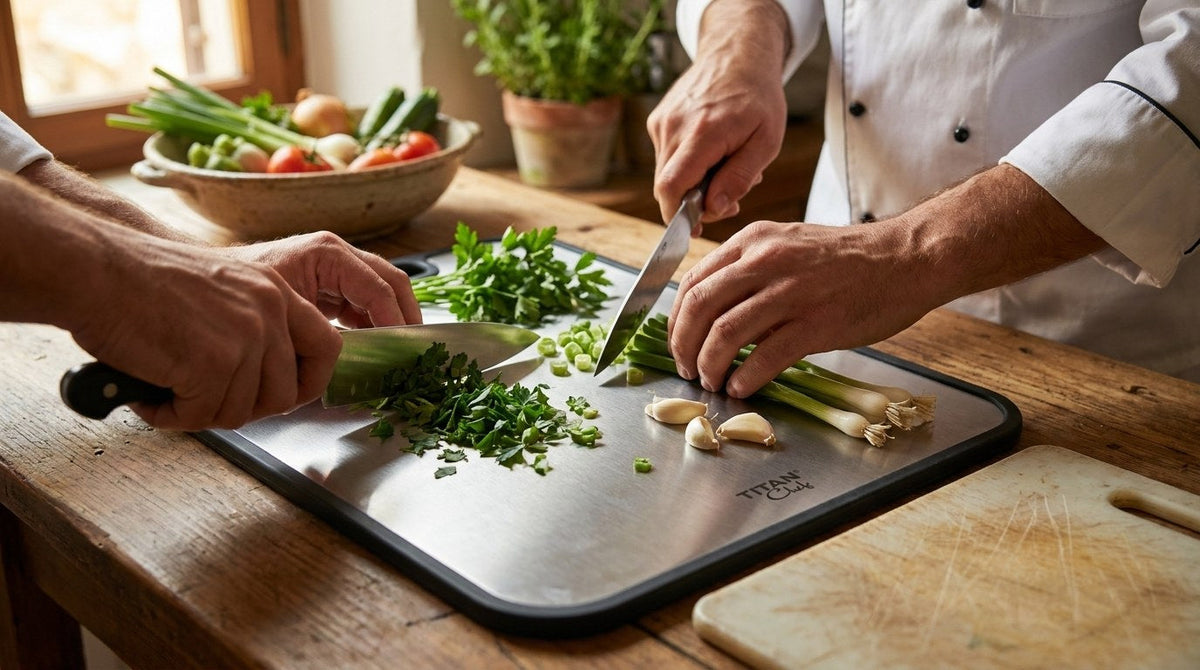
This is the most direct step when it comes to cutting board alternatives for microplastic-free cooking. A stainless steel cutting board does not release microplastics into food. The material is non-porous, so bacteria and odours do not settle in it the way they can in the scratches of a plastic board. The TitanChef cutting board is made of 304 food-grade stainless steel and goes in the dishwasher without any problem, which is practical if you cook for a family every day.
A wooden cutting board is also an option without microplastic release, but it needs more maintenance: regular oiling, washing by hand and not leaving it wet for too long. If you do not want that extra work, you will usually choose stainless steel.
Pay attention to plastic plates, cups and cutlery for children
Plastic plates and cups sold especially for children are often considered safer than other plastic products. But microplastics can also be released from plastic tableware, especially when used with hot food or hot drinks. Eating and drinking from these products can increase the PET content in the body. Glass or stainless steel alternatives are a step in the right direction.
Baby bottles and hot water: be careful
Irish researchers published in Nature Food that bottle-fed babies are estimated to take in millions of microplastics every day. That figure is partly so high because plastic bottles are sterilised with hot water or the feed is prepared warm in them. Heat speeds up the release of microplastics from plastic. Glass or stainless steel bottles are alternatives that avoid that problem.
Take a critical look at other plastic kitchen items
Tips for parents who want a microplastic-free kitchen go further than just the cutting board. Plastic measuring jugs, plastic spatulas and plastic colanders can all release microplastics, especially in contact with hot or fatty food. Replacement does not have to happen in one go: prioritise the items that have the most contact with hot food for children.
A complete overview of kitchen items that spread microplastics can be found in the blog Top 10 items in your kitchen that spread microplastics.
Why a stainless steel cutting board fits logically in a child-safe kitchen
A stainless steel cutting board as an alternative for microplastic-free cooking solves a concrete problem. The material does not wear in a way that leaves particles in the food. 304 stainless steel is non-porous, which also means bacteria cannot settle in scratches, an extra advantage if you cut raw meat or fish for children on the same board.
The TitanChef Original and PRO are both made of this material. The PRO also has a non-slip edge all round and a raised rim that keeps juices on the board, which is practical when you cut juicy ingredients for children's meals: no juice on the worktop, and the board stays in place. Both versions are dishwasher safe, which saves time if you cook for a family every day.
This is not a miracle cure. But it does remove a source of microplastics that you can switch off as soon as tomorrow. That is exactly why choosing a different cutting board is one of the most direct and simple steps parents can take when it comes to microplastics, children and the kitchen and reducing exposure.
Frequently asked questions about microplastics, children and the kitchen
Why do children take in more microplastics than adults?
Children take in microplastics via several routes at once: via plastic bottles, toys they put in their mouths, the air close to the floor and the food prepared for them. Research by the New York School of Medicine showed that the concentration of PET microplastics in the stool of infants can be ten to twenty times higher than in adults. In addition, children inhale up to three times more microplastics than adults, because they are smaller and live closer to the floor, where dust particles accumulate.
Are microplastics harmful to babies and young children?
To be honest, science has not reached a verdict on this yet, but the indications are serious enough to be cautious. Microplastics have now been found in human blood, the placenta and lung tissue. The bodies and immune systems of babies and young children are still developing, which makes them more sensitive to possible health effects than adults. Researchers point to possible inflammatory reactions and endocrine-disrupting effects of substances that plastic can carry, such as phthalates and BPA-like compounds.
Are microplastics released from a plastic cutting board when I prepare children's food on it?
Yes, research by North Dakota State University (Yadav et al., 2023), published in Environmental Science and Technology, shows that a plastic cutting board can release tens of millions of microplastic particles per year into food with daily use. Those particles come loose as soon as a knife passes over the surface and end up directly in the ingredient you are cutting. That also applies to vegetables, fruit and other ingredients you prepare for children's meals.
What is the difference between microplastics and nanoplastics, and which are more dangerous for children?
Microplastics are particles smaller than five millimetres. Nanoplastics are much smaller still: smaller than a micrometre, and therefore completely invisible to the naked eye. The problem with nanoplastics is that their size makes it easier for them to pass through cell membranes and tissues, including the intestinal wall and possibly even brain cells. For children, nanoplastics are of extra concern, because their tissues are still developing and may therefore be more permeable. As microplastics break down further, they become nanoplastics. An old, scratched plastic cutting board releases both types of particles.
How can I, as a parent, reduce exposure to microplastics in the kitchen?
The most direct step is replacing plastic cutting boards with plastic-free alternatives, such as a stainless steel cutting board. It also helps to replace plastic cups and plates for children with glass or stainless steel alternatives, and to avoid plastic baby bottles or not prepare hot water in them. The Dutch RIVM advises reducing exposure to microplastics where possible. The kitchen is one of the places where you, as a parent, have the most direct control over that.
Are there alternatives to a plastic cutting board that are safe for preparing children's meals?
Yes. A stainless steel cutting board does not release microplastics into food. The material is non-porous, easy to clean and dishwasher safe, which is practical in a family setting. Those are handy properties, but the core is the material itself: 304 stainless steel does not wear in the same way as plastic and leaves no particles behind in the food you prepare for your children. A wooden cutting board is another option without microplastic release, although it needs more maintenance and is less hygienic with raw meat.
Conclusion
Children are more sensitive to microplastics in the kitchen than adults, and there are concrete reasons for that: more exposure routes at once, higher intake via bottles and toys, and a body and immune system that are still developing. Science is honest about what is still unknown, but the Dutch RIVM and international researchers agree that reducing exposure is the sensible course, especially for young children. The plastic cutting board is one of the easiest sources to remove: a daily source of microplastics that you can replace as soon as tomorrow with an alternative that releases nothing into your family's food.
Below you will find the TitanChef stainless steel cutting boards and more blogs to read.


