



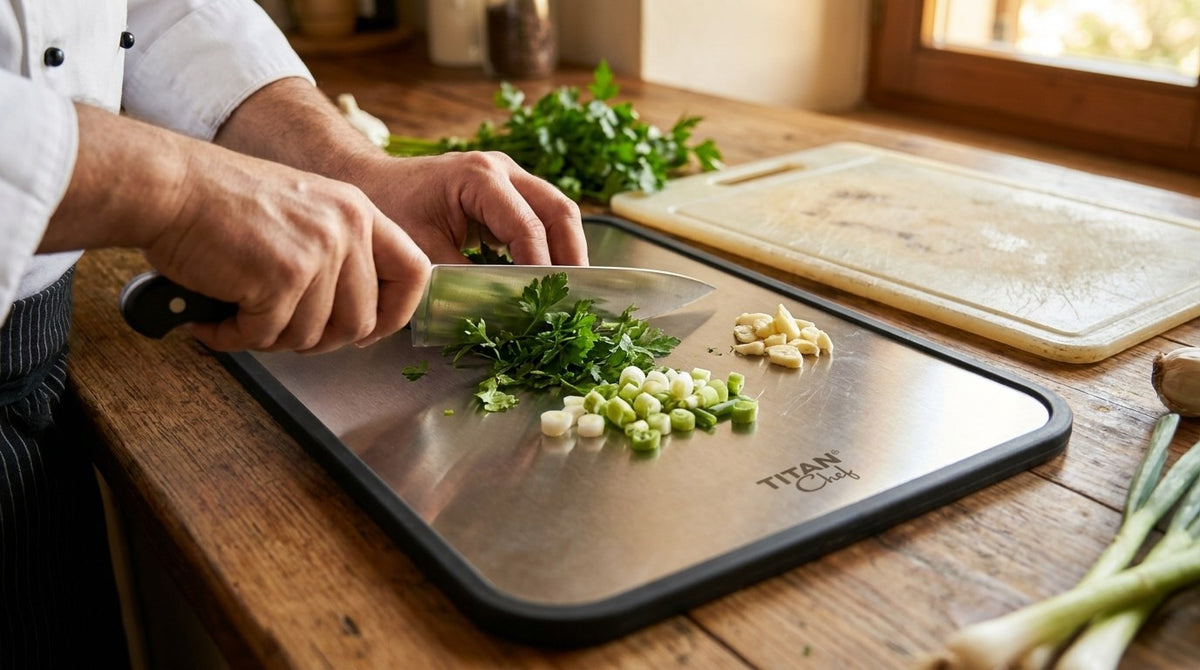
Which cutting board is on your worktop, and do you know what that material does while you cut? It seems like a small choice, but it has more impact on hygiene, health and ease of use than most people expect. In this cutting board material comparison we put plastic, wood, bamboo and stainless steel side by side, honestly. No marketing stories, just concrete information so you can make a choice that serves you for years.
Short answer: No material wins on every point. For raw meat, fish and everyday use without maintenance, stainless steel is the strongest choice: non-porous, dishwasher safe and free of microplastics. For bread and expensive knives, wood is more pleasant, because it is gentler on the edge. Plastic boards shed microplastics when you cut on them.
Plastic cutting board: cheap and popular, but what really happens?
Plastic cutting boards are the standard in many households. They are light, cheap and go in the dishwasher without any problem. That sounds practical, and as a first board the barrier is low. But there are two objections that are becoming increasingly important.
The first objection is bacteria. After a few weeks of use, plastic boards are covered in knife scratches. Those deep grooves are the perfect hiding place for bacteria, which often even survive the dishwasher. Many people underestimate this: a plastic board that looks clean is not necessarily free of bacteria.
The second objection is microplastics. Research published in the scientific journal Environmental Science and Technology (May 2023) confirmed that plastic cutting boards demonstrably release microplastics into food. Researchers at the University of North Dakota calculated that with regular use of a polyethylene or polypropylene cutting board, exposure to microplastics can reach 7.4 to 50.7 grams per person per year, depending on use and material type (Yadav et al., 2023, Environmental Science and Technology). The amount of microplastics released from polypropylene boards is 5 to 60 percent higher than from polyethylene, measured by weight.
Research from the University of North Dakota confirms that regular use of plastic cutting boards exposes people to millions of microplastic particles per year, most of them smaller than 100 micrometres. About half of the released particles stay on the board and disappear with the rinse water. The other half ends up in your food.
Not everything is clear yet about the health risks of microplastics from plastic cutting boards. There is no conclusive evidence yet that cutting board microplastics cause demonstrable harm in humans, but the combination of particle intake and possible migration of chemical substances does raise serious questions for researchers about long-term exposure. That is a reason to be careful, not to panic.
In practical terms: plastic cutting boards are low-maintenance and can be cleaned in the dishwasher, but because they scratch easily they need to be replaced regularly to stay hygienic. A cutting board you replace every year and a half is neither cheap nor eco-friendly in the long run.
Wooden cutting board: a familiar material with clear maintenance needs
Wood has the look of a classic kitchen. A beautiful piece of acacia or beech on the worktop feels familiar. And to be fair, wood has real advantages too. It is kind to knives, relatively soft as a work surface, and good-quality traditional wood lasts a long time.
When it comes to hygiene, the story is more nuanced than it used to seem. Research by an American scientist and later by Wageningen University showed that micro-organisms do stay behind more easily on wood, but that they are largely drawn into the wood, which limits transfer to food. Wood has natural antimicrobial properties that partly explain this.
Still, there is a clear limitation: wood is naturally porous, with microscopic openings and grain. When you cut meat or chicken, the juices are drawn into those pores. Even after thorough washing, bacteria can survive deep in the wood. That makes wood less suitable if you prepare raw meat or fish every day.
Maintenance is an important factor in this cutting board material comparison of wood versus other materials. Wood needs regular care, such as oiling to prevent drying out and cracking. Wooden cutting boards cannot go in the dishwasher, because it damages the wood. They need to be washed by hand and dried well. Without this care, wooden boards can warp or split.
The oiling routine works like this: use a food-safe mineral oil or linseed oil, apply it with a cloth, let it soak in overnight and wipe off the excess. Do this once a month, or whenever the wood feels dry. It is not complicated, but it does take discipline. If you are happy to do that, wood works fine. If you would rather avoid the effort, another material is a better choice.
Bamboo cutting board: a sustainable image, but a few reservations
Bamboo is often presented as the green alternative. It grows fast, is renewable and looks sleek. But in practice there are a few things to keep in mind.
Bamboo is harder than most traditional types of wood. That sounds like an advantage, but for knives it is the opposite: the harder the surface, the faster the blade shows wear. If you have good knives and want to keep them sharp for a long time, you will notice the difference.
Bamboo is also technically a grass, not a wood. Its fibre structure makes the surface more prone to cracking with changing humidity. Many bamboo boards are also glued together, and the quality of that glue varies by product. With intensive use or frequent contact with a lot of moisture, that is something to watch. Like wood, bamboo needs regular care: no dishwasher, regular oiling, and drying it well after use.
In terms of hygiene, bamboo behaves much like wood. No microplastics, but no non-porous surface either. For cutting herbs, vegetables and fruit, bamboo is a fine choice. For daily work with raw meat or fish, a non-porous material is more reliable.
Glass cutting board: hygienic, but hard to recommend
Glass is non-porous and therefore easy to keep clean in theory. Bacteria do not cling to the surface. Still, glass is hard to recommend as a cutting board material, and the reason is simple: a glass or marble board is not a good idea, because those materials are so hard that they blunt knives quickly. That applies to glass in particular. Every cut damages the blade. Cutting on glass also produces a piercing sound that quickly becomes annoying in practice.
So glass has one advantage (hygiene) and several drawbacks (knife damage, noise, risk of breaking). For most home cooks, that rules it out as a serious option for the everyday kitchen.
The benefits of a stainless steel cutting board: the deciding factor in this comparison
Stainless steel combines the hygiene benefits of glass with the practical ease of use that glass lacks. It is non-porous, so bacteria and moisture cannot settle into the surface. When it comes to hygiene, a stainless steel cutting board is often the best choice. Stainless steel is non-porous, which means bacteria and food residue find it hard to cling to it. That makes a stainless steel cutting board extremely easy to clean. The material is dishwasher safe and also resistant to stains and odours.
That last point makes a big difference in practice: after raw meat or fish, you simply rinse the board and put it in the dishwasher. No odours soaking into the surface, no visible discolouration, no soaking in lemon juice. The next morning the board looks exactly the way it did the day before.
Stainless steel releases no microplastics. That sets it fundamentally apart from plastic. Stainless steel has a long lifespan and a smooth, non-porous surface that is easy to clean thoroughly. Stainless steel cutting boards are durable, easy to clean and do not absorb bacteria.
The lifespan of a good stainless steel cutting board is considerable. Stainless steel cutting boards are known for their exceptional durability. They can easily last 10 to 15 years, even with daily use. That quickly makes the purchase worthwhile: if you replace a plastic board every year and a half, you end up spending more in the long run.
One point to be honest about: stainless steel is harder than wood. That affects how quickly knives wear, especially with intensive daily use. If you work with good-quality knives and sharpen them regularly, it is not a big issue in practice. Light scratches on the stainless steel surface are normal for this material and have no effect on hygiene or functionality.
Going for stainless steel? The TitanChef Original is a cutting board made from 304 stainless steel that lasts for years.
Still in doubt? Read our honest comparison: titanium or stainless steel cutting board.
Cutting board materials compared
Every material has its strengths and weaknesses. Below you will find wood, bamboo, plastic (PE or HDPE), glass and stainless steel side by side on the points that matter in practice.
- Wood: no microplastics; porous, absorbs moisture and cannot go in the dishwasher; the kindest to knives; needs regular oiling and hand washing; lasts a long time with good care.
- Bamboo: no microplastics; harder and slightly less porous than wood, but can crack or splinter; usually not recommended for the dishwasher; slightly less kind to knives than wood; needs oiling and hand washing; reasonable lifespan, can crack.
- Plastic (PE or HDPE): sheds microplastics when cutting (ACS research, 2023); non-porous when new, but scratches become hiding places for bacteria; dishwasher safe; kind to knives; low maintenance, replace when deeply scratched; limited lifespan.
- Glass: no microplastics; non-porous, smooth and easy to clean; dishwasher safe; very hard, blunts knives the fastest; low maintenance; long lifespan, but can break.
- Stainless steel (304): no microplastics; non-porous, smooth and easy to clean thoroughly; dishwasher safe; harder than wood and plastic, knives go blunt slightly faster (honing with a honing steel largely solves this); no maintenance; very long lifespan.
Which cutting board should you choose for each situation?
- Raw meat and chicken: choose a non-porous board that you can clean thoroughly and in the dishwasher, and keep it separate from vegetables. Stainless steel is strong here: non-porous, dishwasher safe and free of microplastics.
- Vegetables and fruit: any material works. Stainless steel and plastic are quick to clean; wood is pleasant to cut on.
- Bread: wood is more pleasant. Bread does not require strict raw-meat hygiene, and a softer surface gives a finer cut.
- Expensive or Japanese knives: choose wood. The soft surface spares the edge the most.
- No maintenance, or everything in the dishwasher: choose stainless steel. No oiling, dishwasher safe, non-porous and free of microplastics.
To prevent cross-contamination, use a separate cutting board for raw meat or fish. This is also the advice of the Dutch Nutrition Centre, the Voedingscentrum. That plastic cutting boards shed microplastics when you cut on them has been researched and published in Environmental Science and Technology (2023): depending on the material, this amounts to an estimated few grams to tens of grams per person per year.
Frequently asked questions about cutting board materials
Which cutting board material is the most hygienic: wood, plastic or stainless steel?
Stainless steel scores best on hygiene. The material is non-porous, so bacteria and moisture cannot settle into the surface. Plastic boards develop deep scratches over time that act as hiding places for bacteria, even after a run through the dishwasher. Wood has natural antimicrobial properties, but it is porous and draws in moisture and bacteria, which makes it less suitable for intensive use with raw meat.
Are plastic cutting boards dangerous because of microplastics?
Plastic cutting boards demonstrably release microplastics into food during normal cutting. Research by Yadav et al. (2023), published in Environmental Science and Technology, calculated that with regular use a plastic cutting board can release up to 50.7 grams of microplastics per person per year. Whether and how harmful that is in the long term is still being researched. The WHO states that more research is needed, but the indications that microplastics accumulate in body tissue are reason enough to take a critical look at your choice of cutting board.
Does a stainless steel cutting board make your knives blunt faster?
Stainless steel is harder than wood or plastic, and that affects how quickly the blade wears. With daily use of good-quality knives, this is something to keep in mind: sharpen your knives regularly and use a honing steel in between. Many home cooks who switch to stainless steel find that with good knives and normal use they notice no significant difference in how quickly their knife goes blunt. Cheap knives made of softer steel will wear faster on a hard surface.
Can a wooden cutting board go in the dishwasher?
No, a wooden cutting board is not suitable for the dishwasher. The high moisture and heat of a dishwasher cycle penetrate deep into the wood, leading to warping, splitting and faster wear. Wooden boards are best washed by hand under warm water with a little washing-up liquid, then dried immediately and stood upright so they can dry properly. Regular oiling with a food-safe oil helps keep the wood supple and intact.
When should you replace a plastic cutting board?
A plastic cutting board should be replaced as soon as deep scratches and grooves are visible in the surface. Bacteria settle into those grooves and even survive a dishwasher cycle, while the release of microplastics increases as the surface wears further. With intensive daily use, that can be necessary after just a year or a year and a half. If you want to avoid that replacement cycle, you are better off choosing a durable alternative such as a stainless steel cutting board that lasts for years without replacement.
Is a bamboo cutting board better than a wooden cutting board?
Bamboo is often presented as a sustainable alternative, but it has a few drawbacks compared with traditional hardwood. Bamboo is harder than most types of wood, which affects knife sharpness more quickly. Bamboo is also technically a grass, with a fibrous structure that is more prone to cracking with moisture and changing temperatures. Many bamboo boards are also glued together, which is a concern with intensive use or prolonged contact with moisture. In terms of hygiene and maintenance, bamboo behaves much like wood: no dishwasher, regular oiling.
Should you use separate cutting boards for raw meat and vegetables?
Yes, that is the most practical way to prevent cross-contamination. Bacteria from raw meat, such as salmonella, can stay on the board and then end up on raw vegetables that you will not cook. With a stainless steel cutting board such as the TitanChef, you can simply flip it over: use one side for raw meat and the other side for vegetables or fruit. That way you work with one board and minimise the risk of cross-contamination, without having to store several boards.
What is the best cutting board?
There is no single best cutting board for everyone: it depends on what you use it for. For raw meat, fish and maintenance-free use, stainless steel is a strong choice, because it is non-porous, dishwasher safe and releases no microplastics. For bread and expensive knives, wood is a better choice, because it is gentler on the edge.
Which cutting board does not release microplastics?
Cutting boards made from stainless steel, glass, wood and bamboo contain no plastic and therefore release no microplastics. Plastic cutting boards (PE, HDPE or PP) do release them when you cut, according to research published in Environmental Science and Technology in 2023.
Conclusion: which cutting board material should you choose?
Every material has its place, but the differences are big. Plastic is cheap, but scratches quickly, giving bacteria a place to settle, and it sheds microplastics with use. Wood and bamboo are pleasant to cut on, but need regular care and do not belong in the dishwasher. Glass is hygienic, but bad for your knives.
A stainless steel cutting board combines the advantages: non-porous, dishwasher safe, free of microplastics and it lasts for years. The only thing to keep in mind is that you hone your knives a little more often. If you want one cutting board that stays hygienic and needs little maintenance, stainless steel is the most logical choice.
Curious about the TitanChef stainless steel cutting boards? Take a look at them below. You will also find more blogs to read there.


