



Environmentally friendly cooking does not only start with organic ingredients or an energy-efficient oven. It starts with the things you work with every day. The cutting board is one of them, and it is a choice most people make once and then never think about again. Yet one material differs enormously from another, both for the environment and for your health.
In this article we compare the four most commonly used cutting board materials: plastic, wood, bamboo and stainless steel. Which sustainable cutting board is best for your kitchen? Which material releases substances into your food? And what is the most sensible choice if you want to avoid microplastics in the kitchen? You can read it here.
Why the material of a sustainable cutting board matters
A cutting board seems like a simple piece of kitchen equipment, but it is the surface on which you prepare vegetables, meat and fruit. Whatever that board releases comes into direct contact with your food. At the same time, sustainability plays a role: how long does the material last, what is the environmental impact of production, and what do you do with it when the board needs replacing?
The most commonly used materials are plastic (polyethylene or polypropylene), hardwood (such as acacia or beech), bamboo and stainless steel. They differ on four points that matter for sustainable cooking: lifespan, material safety, maintenance and recyclability.
Plastic cutting board: cheap, but not sustainable
The plastic cutting board is the standard choice in most kitchens. It is light, affordable and goes in the dishwasher without any trouble. But if you look at the total life cycle, plastic is the least sustainable material of the four.
Plastic boards wear quickly. Over time, deep scratches form, after which bacteria settle in grooves that even a dishwasher can no longer reach. The average service life is one to three years, after which the board ends up as waste: not compostable, and hardly recyclable in practice.
Then there is the issue of microplastics. Scientists at North Dakota State University (Yadav et al., 2023) calculated that a plastic cutting board can release up to 50 grams of microplastics per year with normal use, directly into the food you prepare. Research by the University of Queensland showed that every cut on a plastic board can release an average of around 14,800 microplastic particles. In the same study, wooden and bamboo boards released only a few hundred particles.
The Dutch broadcaster BNNVARA and researcher Himani Yadav confirm that cutting carrots on polyethylene or polypropylene boards can release as many as 79 million plastic particles per year. The exact health effect is still being studied, but the particles do come into contact with your food. If you want to replace your plastic cutting board with a sustainable option, this is the argument to start with.
Wooden cutting board: a trusted material with maintenance requirements
Hardwood is a renewable raw material and one of the oldest materials for cutting boards. Types such as acacia and beech can withstand intensive use and have natural antimicrobial properties: bacteria are drawn deeper into the wood and survive worse there than in the scratches of plastic.
A good wooden cutting board does not release substances into food and is knife-friendly: the softer surface absorbs part of the cutting force, so knives stay sharp for longer. With good maintenance, a hardwood board lasts five to ten years, sometimes longer.
The downside is maintenance. A wooden board needs regular oiling with mineral oil or special cutting board oil to stop the wood from drying out, cracking or holding on to bacteria. Washing it in the dishwasher is not recommended: the heat and prolonged contact with water open up the fibres, causing the board to warp or crack. Hand washing with warm water and mild soap is the standard.
For anyone who wants to treat their kitchen equipment with care, hardwood is a solid choice. It requires discipline in maintenance, but gives you a board that serves you for years without having to throw it away.
Bamboo cutting board: a sustainable image, but with a caveat
Bamboo is often presented as the most environmentally friendly material. That is partly justified: bamboo grows extremely fast, up to a metre a day, making it one of the fastest renewable raw materials in the world. The plant needs little water and grows without pesticides.
Yet the sustainable image of bamboo is more nuanced than it seems at first glance. Bamboo cutting boards consist of strips of bamboo glued together. With many cheaper products, this is done with melamine resin, a compound of melamine and formaldehyde. Research by the Dutch food safety authority NVWA and the German Stiftung Warentest showed that certain bamboo products can release excessive concentrations of formaldehyde during use. For cutting boards, the conditions are different from tableware used for hot drinks, but it is a point to take seriously.
When buying a bamboo cutting board, it is wise to check the certification of the glue used. Boards with demonstrably formaldehyde-free, food-safe glue do exist, but cheap boards without certification deserve more scepticism than their green image suggests. So be critical: not every bamboo board is as environmentally friendly as the packaging promises.
Stainless steel cutting board: the most sustainable choice for a zero waste kitchen
Stainless steel is the material that scores strongest on all sustainability criteria when you look at the full life cycle. A stainless steel cutting board lasts ten to fifteen years with normal home use, keeps its structure and does not release substances into food.
The surface of 304 stainless steel is non-porous. Bacteria and odours cannot penetrate it, as they can with wood in poor condition or with scratched plastic boards. After raw meat or fish: rinse it, and the board is ready for use again. If you want to clean it more thoroughly, the board simply goes in the dishwasher.
From a zero waste kitchen perspective, the long lifespan is the strongest argument. A plastic board you replace every two years produces five disposable products over ten years. A stainless steel board that lasts ten years produces one. And at the end of its service life, stainless steel is fully recyclable, unlike plastic.
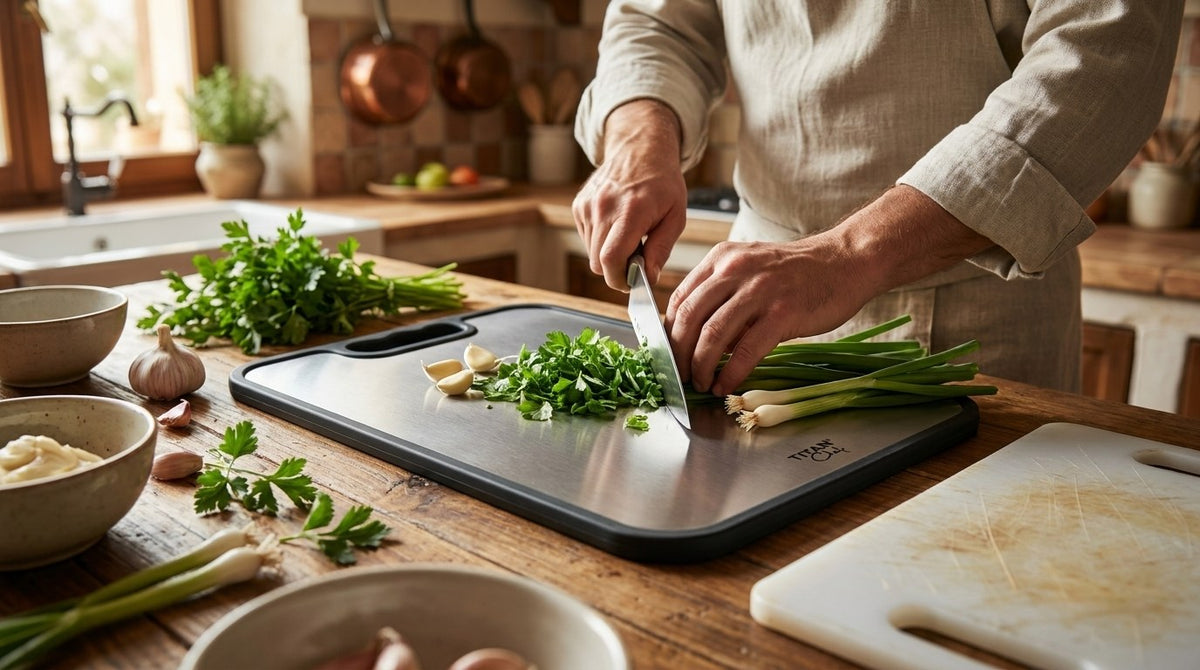
The TitanChef stainless steel cutting board is made of food-grade 304 stainless steel with a brushed surface. That surface is not mirror-smooth, but gives just enough grip for stable cutting. The board is dishwasher safe and needs no oil and no special maintenance. For anyone who wants to avoid microplastics in the kitchen while getting rid of the maintenance of a wooden board, this is the logical end point of the comparison.
Want to know more about how plastic cutting boards behave over the years? In the blog about plastic cutting board scratches, bacteria and microplastics you can read what is in those grooves after a year of use.
The four materials compared: which sustainable cutting board material wins?
Below are the four materials side by side, assessed on the criteria that matter for sustainable cooking:
- Plastic: short lifespan (1-3 years), releases microplastics into food, not biodegradable, hardly recyclable in practice. Cheap to buy, but a false economy over the years.
- Hardwood: lifespan of 5-10 years with good maintenance, renewable raw material, no microplastics, knife-friendly. Drawback: needs regular oiling, not dishwasher safe, sensitive to moisture if neglected.
- Bamboo: fast-renewable raw material, harder than wood, less sensitive to moisture than traditional wood. Caveat: many boards contain glue with melamine or formaldehyde. Always check the certification.
- Stainless steel: lifespan of 10-15 years, does not release substances into food, non-porous, fully recyclable, dishwasher safe, no maintenance required. Higher purchase price, but the lowest cost and impact per year of use.
No material scores perfectly on every front. But if you ask which sustainable cutting board needs replacing least, releases the least and needs the least maintenance, the comparison points to stainless steel.
Practical guide: how to make the switch to more sustainable cooking
You do not have to replace everything at once. A few targeted choices already make a noticeable difference:
- Replace your plastic cutting board first. This is the source in your kitchen that is easiest to switch off, and the one that releases the most microplastics with daily use.
- Choose stainless steel if you do not want any maintenance obligation. Choose hardwood if knife-friendliness matters more to you than convenience.
- With bamboo, always check the certification of the glue used. No certification mentioned? That is a reason for caution.
- Make your board last longer by treating it well. For a stainless steel board, that means: avoiding aggressive cleaning products and wiping it dry after washing.
- Do not throw a board away at the first scratches. With stainless steel, light scratches are purely cosmetic and have no effect on hygiene or performance.
Environmentally friendly cooking is not about perfection. It is about removing the sources that contribute most to pollution in your direct surroundings. The cutting board is one of the easiest.
Going for stainless steel? The TitanChef Original is a 304 stainless steel cutting board that lasts for years.
Want to know more about the differences? Also read comparing cutting board materials: plastic, wood, bamboo or stainless steel.
Frequently asked questions about the sustainable cutting board: which material is the best choice?
Which cutting board material is the most environmentally friendly: wood, bamboo, plastic or stainless steel?
Plastic scores worst: it wears quickly, releases microplastics and ends up as waste after one to three years on average. Wood is a renewable raw material and lasts a long time with good maintenance, but needs oil and hand washing. Bamboo grows fast and is naturally renewable, but many bamboo boards contain melamine or formaldehyde-based glue, which raises questions about safety and how environmentally friendly they really are. Stainless steel lasts ten to fifteen years, is fully recyclable and does not release substances into food. Over the full life cycle, stainless steel is therefore one of the strongest choices for the home kitchen.
Are microplastics released when you cut on a plastic cutting board?
Yes, this has been confirmed in several studies. Scientists at North Dakota State University (Yadav et al., 2023) calculated that a plastic cutting board can release up to 50 grams of microplastics per year with daily use, straight into the food you prepare. Research by the University of Queensland showed that every cut on a plastic board can release an average of around 14,800 microplastic particles, while wooden and bamboo boards released only a few hundred particles. Whether and to what extent those particles are actually absorbed by the body is still the subject of further research, but the particles do come into contact with the food.
Do bamboo cutting boards contain harmful substances such as resins or glues?
That depends strongly on the manufacturer and the production technique used. Bamboo cutting boards consist of strips of bamboo glued together. With cheaper products, this is done with melamine resin, a compound of melamine and formaldehyde. Research by the Dutch food safety authority NVWA and the German Stiftung Warentest showed that some bamboo products release excessive concentrations of formaldehyde during use. For cutting boards the risk is lower than for tableware used for hot drinks, but it is wise to choose boards with food safety certification and demonstrably formaldehyde-free glue.
How long does a sustainable cutting board last?
That varies greatly per material. A cheap plastic cutting board needs replacing on average every one to three years because of wear and deep scratches. A wooden board lasts five to ten years or longer with good maintenance, regular oiling and hand washing. A stainless steel cutting board lasts ten to fifteen years with normal use without losing function or hygiene. The longer a board lasts, the smaller its environmental impact per year of use, and the better the ratio between purchase price and service life.
Can a wooden or bamboo cutting board go in the dishwasher?
No, that is not recommended for either material. The heat and prolonged exposure to water in a dishwasher open up the wood fibres, which can cause the board to crack, warp or fall apart. Bamboo is slightly less sensitive to moisture than traditional wood, but bamboo boards are also generally not recommended for machine washing. Stick to hand washing with warm water and mild soap, followed by drying straight away and leaving it upright so both sides get air.
Is a wooden cutting board more hygienic than a plastic cutting board?
That is more nuanced than it seems at first glance. A new plastic board is easy to clean, but over time scratches form in which bacteria settle and can hardly be removed, not even in the dishwasher. Hardwood has natural antimicrobial properties: bacteria are drawn deeper into the wood and survive worse there than in the scratches of plastic. A wooden board does need more maintenance: regular oiling and always hand washing.
What is the most sustainable alternative to a plastic cutting board?
If you want to replace a plastic cutting board with sustainability in mind, stainless steel and solid hardwood are the strongest alternatives. Stainless steel lasts ten to fifteen years, does not release substances into food, is fully recyclable and never needs oiling. Hardwood such as acacia is knife-friendly and a renewable raw material, but needs more maintenance. Bamboo is attractive because of its fast growth, but always ask about the certification of the glue used when buying.
Conclusion: the sustainable cutting board choice is clearer than you think
Plastic is the material that scores weakest on every front: short lifespan, microplastics in your food, and no meaningful recycling option. Wood is an honest alternative for those willing to take on the maintenance. Bamboo has an attractive story, but calls for a critical look at the glue used. Stainless steel scores strongest when you look at lifespan, safety and total environmental impact: no substances released, no maintenance, simply into the dishwasher. A sustainable stainless steel cutting board is a one-off choice that lasts for years, and therefore the most logical step for anyone who really wants to improve their kitchen. Also take a look at the extensive cutting board material comparison if you want to compare the four materials in even more detail.
Below you will find the TitanChef stainless steel cutting boards. You will also find more blogs there if you want to read on.


