



A bargain cutting board or one that costs several times as much: for many people that feels like a choice without big consequences. Yet there is more to it than just the price. When you compare cutting board materials, you quickly see that cheap and expensive differ fundamentally on three points: lifespan, hygiene and what ends up in your food while you cook. Together, those three points determine which cutting board is the wisest choice in the long run.
In this article we compare plastic, wood and stainless steel on every relevant point. No sales pitch, just concrete information so you can make a well-founded choice.
Why comparing cutting board materials pays off: the price only tells half the story
A cheap plastic cutting board looks fine when you buy it. It is light, easy to clean and fits into any kitchen cupboard without a second thought. But the purchase price does not tell the whole story. You calculate the real cost of a cutting board over its entire period of use: how long does it last, what does maintenance cost, and what hidden consequences does the material have?
Cheap plastic cutting boards need to be replaced regularly, which ends up more expensive in the long run than a quality alternative. If you buy a new plastic board every year or two, you spend more over ten years than someone who invests once in a durable option. And that is only the wallet side of the story.
The hygiene side and the microplastics side weigh at least as heavily. You only discover that when you really put the materials side by side.
Plastic cutting board: cheap to buy, costly in the long run
Plastic is the best-selling cutting board material. The advantages are clear: low price, light weight, dishwasher safe. For everyday use it seems like a logical choice. Until the first few months have passed.
With intensive use, deep grooves and scratches soon appear in the surface. Bacteria settle into those grooves and survive there even after thorough cleaning. That is a hygiene problem that eventually affects every plastic cutting board, whatever the price of the model. As soon as deep cut marks are visible, the board is really due for replacement.
Microplastics: the least visible but most underestimated drawback
There is a second drawback to plastic that has only recently been mapped scientifically: microplastics. Research published in Environmental Science & Technology (Yadav et al., 2023) showed that with normal use, polyethylene and polypropylene cutting boards can release up to 50 grams of microplastics per year into food. Every time you cut a carrot in half, particles come loose from the surface and end up in your ingredients.
In the same study, polypropylene boards, the slightly cheaper variant, released 14 to 71 percent more particles than polyethylene boards. In other words: the very cheapest option in the supermarket is often also the worst for microplastic release. The researchers described plastic cutting boards as "an overlooked source" of microplastic exposure in the home kitchen.
What these particles do in the body is still the subject of ongoing research. Microplastics have now been found in human blood, lung tissue and arterial plaque. In a clinical study published in the New England Journal of Medicine (2024), patients with microplastics in their artery walls had an increased risk of heart attack and stroke compared with patients without. Causality has not yet been proven, but the indications are serious enough to take seriously. You can read more about this topic in our more extensive article on whether microplastics are harmful to health.
The conclusion for plastic cutting boards is clear: no plastic cutting board material is completely free of microplastic release. The only way to avoid this risk through your cutting board is to switch to a non-plastic alternative.
Wooden cutting board: a familiar material with a few serious catches
There is something reassuring about a wooden cutting board. It feels solid, is kind to knives and looks good on the worktop. For many home cooks it is the default choice, and that choice is not illogical. Wood has some natural antimicrobial action: wood fibres draw bacteria inside, where they die under dry conditions.
Still, there are drawbacks that weigh heavily with intensive use. Wood is porous. Juices from raw meat or fish soak into the fibres and cannot be completely removed with ordinary cleaning. Without regular oiling, the board dries out, which leads to cracks and eventually splitting. A wooden board that is not properly maintained wears out faster than you might think, and it cannot go in the dishwasher either.
With good maintenance, a wooden cutting board lasts five to ten years. That is considerably longer than plastic, but it does require consistent work: oiling, washing by hand, drying straight after use. If you do not mind that, a quality wooden board is a serious option. If you want to cook without the hassle, the maintenance is a hurdle.
Comparing cutting board materials: where stainless steel stands out
Stainless steel, specifically food-grade 304 stainless steel, combines the advantages of wood and plastic without the biggest drawbacks of either. The material is completely non-porous: bacteria, moisture and odours do not penetrate the surface. After cutting raw meat, a rinse is enough, and the board can simply go in the dishwasher. No oiling ritual, no special cleaning products, no hand-washing requirement.
The difference with plastic is concrete: a stainless steel board releases no microplastics into food. The material does not wear that way. Surface scratches can appear, but they are purely cosmetic and have no effect on hygiene or functionality. That is the fundamental difference when you compare cutting board materials in terms of food safety.
When it comes to lifespan, the difference is just as big. With normal use, a stainless steel cutting board lasts for years without the material deteriorating. There are no replacement costs every year or two, and no maintenance to plan. It costs more to buy than a cheap plastic board, but over a period of five or ten years the sums are quickly done.
The drawback most often mentioned for stainless steel: it is less kind to knives than wood. That is true. Wood gives a little while you cut, which keeps the knife sharp for longer. With a brushed stainless steel surface the effect is limited for normal home use, but if you work with expensive knives every day, it is wise to have them sharpened regularly. That applies to every material, including wood.
Would you like a more in-depth comparison of all common materials side by side? You will find it in our article on cutting board materials compared: plastic, wood, bamboo or stainless steel.
What really determines the price of a cutting board
When you compare cutting board materials, you see that the purchase price depends on three things: the material itself, the finish and the construction. A cheap plastic board is thin, deforms quickly under pressure and has little structural strength. A more expensive board, whether a thick wooden board or a sturdy stainless steel model, has more weight, more stability on the worktop and a longer service life.
Stability is a point that is easily overlooked with cutting boards. A board that slides away while you cut a pumpkin or a piece of meat costs time and is a safety risk. More expensive boards offer more grip, sometimes through rubber feet or edges, sometimes simply through weight and mass.
The surface finish also determines how long the board does its job well. A brushed stainless steel surface gives the knife just enough grip without the material getting damaged quickly. A thin, cheap plastic board is already covered in shallow scratches within the first weeks of intensive use, and those scratches deepen as the months go by.
When should you replace a cutting board?
For plastic, the rule of thumb is: replace it as soon as deep grooves appear that can no longer be cleaned properly. With intensive daily use, that happens after just a year or two. Microplastic release increases as the material deteriorates, so waiting longer works against you in two ways.
For wood: replace it if there are deep cut marks, cracks, mould or a persistent smell that lingers after washing. A well-maintained wooden board with no visible damage can last five to ten years.
For stainless steel, in practice there is no replacement moment based on wear of the material itself. Surface scratches come with use and change nothing about the hygienic properties of the board. Comparing the lifespan of cutting boards made from plastic and stainless steel is therefore clear: plastic is a consumable, stainless steel is an investment.
What makes a hygienic cutting board for your kitchen?
A hygienic kitchen cutting board has three properties. First, a non-porous or easy-to-clean surface, so bacteria and moisture are not trapped. Second, a surface without deep grooves or scratches, because those are hiding places that cleaning cannot reach. Third, practical ease of cleaning, so that cleaning is thorough in practice too and not skipped halfway.
Stainless steel scores well on all three. Wood scores moderately on the first point because of its porous structure, but with good maintenance it partly makes up for that with the antimicrobial action of wood fibres. Plastic scores poorly on the second point once scratches have built up, and the microplastics problem adds an extra dimension. If you want to actively prevent cross-contamination, you can read more in our article on preventing cross-contamination in the kitchen.
The conclusion of the comparison
A cheap plastic cutting board is understandable as a starting point, but it does not hold up for long if you use it seriously. Its lifespan is short, microplastic release is a real and scientifically confirmed fact, and its hygienic properties deteriorate quickly once scratches build up. In the long run, buying cheap is almost always buying twice when it comes to cutting boards.
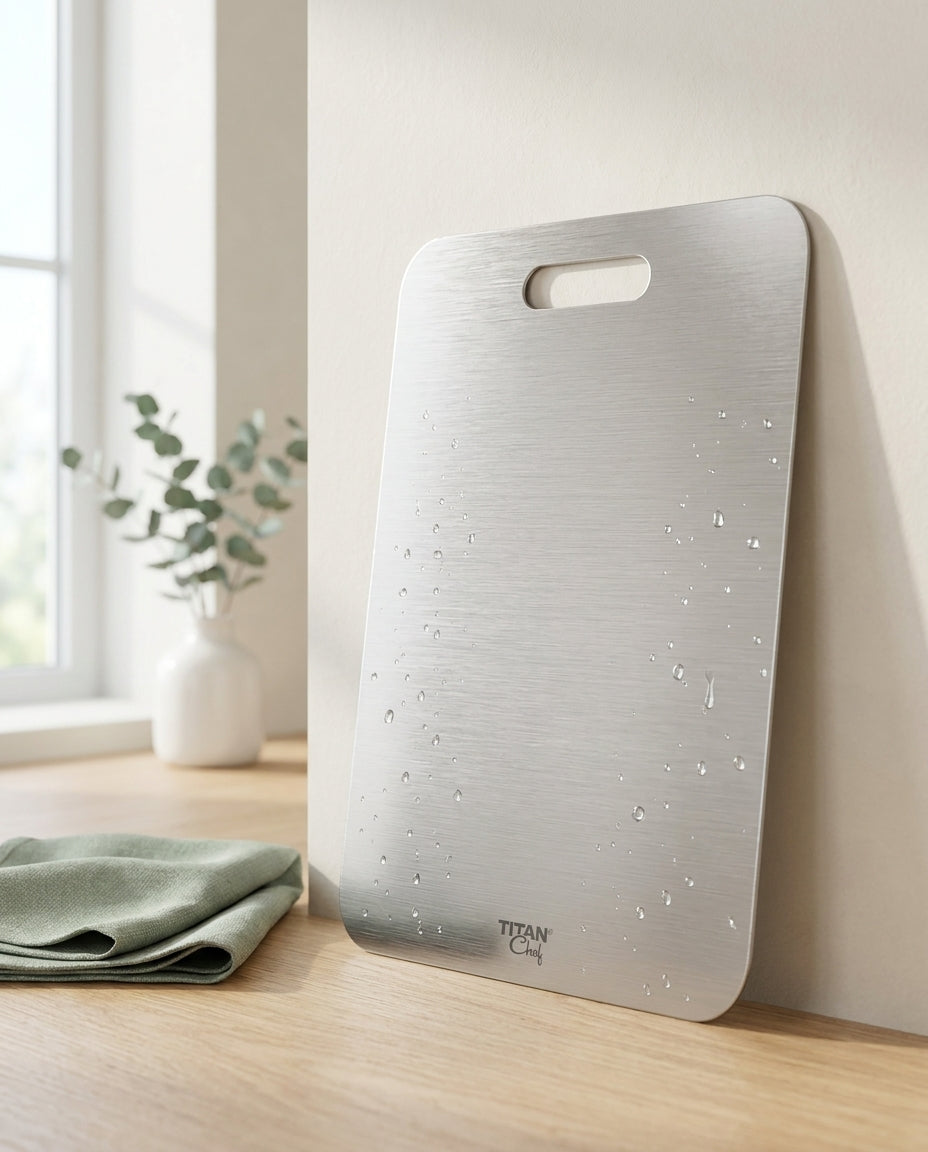
If you compare cutting board materials with health, lifespan and everyday ease of use in mind, you will logically end up with a non-porous, low-maintenance material that releases no particles into food. The TitanChef stainless steel cutting board is made from food-grade 304 stainless steel and scores better than plastic or wood on those three criteria. Not as a brand claim, but as the outcome of what the material comparison shows.
Going for stainless steel? The TitanChef Original is a cutting board made from 304 stainless steel that lasts for years.
Want to know more about the differences? Also read comparing cutting board materials: plastic, wood, bamboo or stainless steel.
Frequently asked questions about comparing cutting board materials
What is the difference between a cheap and an expensive cutting board?
The main difference lies in the material and lifespan. A cheap plastic cutting board costs little to buy, but wears quickly and needs replacing every one to three years. Plastic boards also release microplastics into your food while you cut, which is not the case with quality alternatives such as stainless steel. An expensive cutting board made from a durable material lasts for years, sometimes decades, and therefore means lower costs and fewer health risks in the long run.
Which material is the most hygienic for a cutting board: wood, plastic or something else?
Stainless steel scores best on hygiene, because the surface is completely non-porous. Bacteria and moisture cannot soak into the material, and cleaning is quick and thorough. Wood has some natural antimicrobial action, but it is porous: juices and bacteria soak into the fibres and remain despite cleaning. Plastic seems easy to keep clean, but the scratches that form with use are an ideal hiding place for bacteria. If you want to know exactly how bacteria behave on different materials, read on in our page on the most hygienic cutting board.
Does an expensive cutting board make your knives go blunt less quickly?
That depends on the material. Hard materials such as glass, stone and bamboo blunt knives quickly and are not recommended for that reason. Of all common materials, wood is the kindest to knives, because wood fibres give a little while you cut. Stainless steel is harder than wood, but with a well-brushed surface the effect on your knife's sharpness stays limited with normal home use. If you work with expensive knives every day, it is wise to have them sharpened regularly, whatever the cutting board material.
How long does a cheap plastic cutting board last before you need to replace it?
With normal daily use, a cheap plastic cutting board lasts an average of one to three years before wear becomes visible as deep grooves and scratches. Once those grooves are there, the board needs replacing: bacteria settle into them easily, and the risk of microplastics from a plastic cutting board increases as the material deteriorates. If you buy a new plastic board every year or two, you end up spending more in the long run than with a quality alternative that lasts for years or decades.
Do you ingest microplastics from a plastic cutting board?
Yes, scientific research has confirmed this. A study published in Environmental Science & Technology (Yadav et al., 2023) showed that with normal use, polyethylene and polypropylene cutting boards can release up to 50 grams of microplastics per year into food. The particles are smaller than 100 micrometres and end up directly in the ingredients you prepare. Whether and how harmful this is in the long term is still being researched, but the particles have now been found in human blood, lung tissue and arterial plaque.
When is it time to replace a cutting board?
Replace your cutting board as soon as deep grooves or scratches appear that you can no longer get clean. With plastic boards, that is the signal that bacteria can settle in and microplastic release increases. The same applies to wooden boards: deep cut marks, cracks or a noticeable smell that lingers after washing are signs that the board can no longer do its job safely. A stainless steel cutting board gets surface scratches that are purely cosmetic and have no effect on hygiene or function.
What are the long-term drawbacks of a cheap cutting board?
The drawbacks add up. First, there are the replacement costs: a plastic board that goes in the bin every year or two costs more over ten years than a durable cutting board made from stainless steel or quality wood. Second, there is the microplastic burden: with every cut, particles end up in your food, a risk that does not exist with a stainless steel board. Third, the scratches are a hygiene problem, because bacteria survive in them even after careful cleaning.
Curious about the TitanChef stainless steel cutting boards? Take a look at them below. You will also find more blogs to read there.


