



A budget cutting board or one that costs many times as much: what is actually the difference? Many people buy a cheap plastic board without giving it a second thought. But the material you choose determines how long the board lasts, how hygienically you work and whether unwanted substances end up in your food. This article explains what really matters when deciding which cutting board material to choose, per material and per use.
What determines the quality of a cutting board?
The price of a cutting board says little on its own. What counts is the material, the thickness, the construction and the finish. A thin, bargain plastic board and a solid wooden board that costs many times more are both cutting boards, but they behave very differently in the kitchen.
Cheap boards go wrong on three points: susceptibility to wear, stability and hygiene. A thin plastic board scratches quickly, warps at the first contact with water and needs replacing after one to three years on average. A cheap wooden board made of insufficiently dried wood deforms as soon as it gets wet, because the glue cannot cope with the moisture.
More expensive boards are made more carefully on all those points. That is not always in what you see, but in what is not visible: the drying process of the wood, the quality of the glue and the thickness of the material. With a stainless steel board it works differently: the material does not absorb moisture, has no pores and does not wear in a way that affects food safety.
Plastic cutting board: cheap to buy, expensive to use
A plastic board is the most commonly bought cutting board. Cheap, light and dishwasher safe: that sounds practical. Yet there are serious drawbacks, especially with cheaper versions.
The first problem is wear. A sharp knife leaves small marks in the plastic with every cut. Those knife marks become deeper and wider over time. Bacteria settle in those crevices and survive there even after intensive washing. That is not a matter of sloppy cleaning, but of how the material behaves.
The second problem is the microplastics risk of a plastic cutting board. Research by Yadav et al. (2023), published in the scientific journal Environmental Science and Technology, showed that a plastic cutting board can release up to 50 grams of microplastics per person per year during normal use, directly into prepared food. In that study, polypropylene boards released up to four times more particles than polyethylene boards. A follow-up study (Gan et al., 2025, Environmental Health Perspectives) gave mice the amounts of microplastics released from cutting boards. That led to inflammatory reactions in the gut and changes in the gut flora. What that exposure means for humans in the long term is still being studied, but the particles demonstrably end up in food.
Cheap plastic boards are also thinner than more expensive versions. Thin boards slide around more easily on the worktop, bend when you cut hard and sometimes warp after just a few washes. A thick, high-quality plastic board behaves more stably, but has the microplastics problem just as much as a cheap one.
Read more about the relationship between plastic boards and bacteria in the blog about plastic cutting board bacteria and scratches.
Wooden cutting board: knife-friendly, but demanding to maintain
Wood is the classic cutting board material and there is a real reason for its popularity. A good board of solid hardwood, such as maple, walnut or acacia, is knife-friendly: the knife cuts slightly into the fibres instead of striking hard against them. That spares the knife's edge.
High-quality solid wood also has natural antimicrobial properties. Bacteria such as salmonella die relatively quickly on dry, healthy wood. That is different from scratched plastic, where the same bacteria can survive and even multiply in the knife marks.
The big difference between a cheap and a more expensive wooden board is not in its appearance, but in the production process. High-quality boards are made of wood with a controlled moisture content of around ten percent, with moisture-resistant glue that can handle kitchen conditions. Cheap wooden boards are often made of insufficiently dried wood with glue that cannot withstand prolonged contact with moisture. The result: the board warps at the first wash.
Wooden boards are not dishwasher safe. The heat and aggressive detergents in a dishwasher dry the wood out too quickly, after which cracks and deformation follow. Putting a wooden board in the dishwasher drastically shortens its life. Wood also needs regular maintenance: rubbing it with food-safe oil once a month keeps the fibres nourished and prevents drying and cracking. Skip that, and the board will crack over time.
Wood is also porous. Meat juices and fish residue soak into the fibres and are difficult to remove completely, especially as the board gets older and drier. For people who prepare raw meat and fish, that is a point to consider when weighing up cutting board hygiene, plastic vs wood.
Bamboo cutting board: sustainable look, varying quality
Technically, bamboo is not wood but a grass-like plant that is made into boards by pressing fibres together with glue. That production process determines the quality: cheap bamboo boards contain more glue of varying composition, which affects moisture resistance and durability.
Bamboo is harder than most types of wood, which makes the surface more scratch-resistant. That sounds like an advantage, but it also has a downside: the hard surface is less kind to a knife's edge, especially for high-end Japanese knives. Like wooden boards, bamboo boards are not dishwasher safe and need maintenance. Cheap bamboo boards are prone to cracking when they regularly get wet without oil being applied.
Which cutting board material to choose if you want no maintenance: stainless steel
A stainless steel cutting board works fundamentally differently from plastic, wood or bamboo. The material is non-porous: bacteria do not penetrate it, moisture is not absorbed and no knife marks form that release particles. A stainless steel board wears in a way that does not affect hygiene. Small scratches are purely cosmetic and have no influence on food safety.
The practical advantage is as big as the material advantage. A stainless steel board simply goes in the dishwasher, keeps its shape however wet it gets and never warps. There is no oil, no hand-washing ritual and no moment you have to replace it after a year or two of use. That makes the board economically attractive in the long run, even if it costs more to buy than a cheap plastic board.
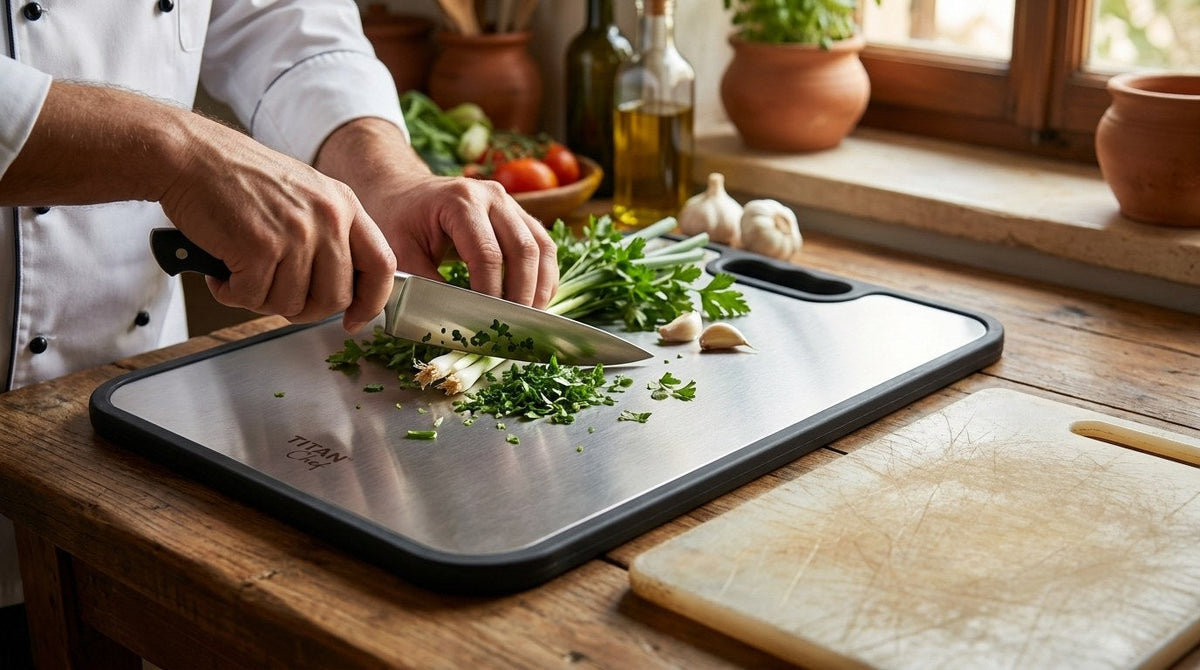
The TitanChef stainless steel cutting board is made of 304 stainless steel with a brushed finish. That gives the surface just enough grip for the knife without the material itself getting damaged quickly. The PRO version also has a rubber edge that stops it from sliding on the worktop, and a raised rim that keeps meat juices and fruit juice on the board. That makes the board particularly useful for juicy ingredients such as watermelon, tomato or a steak you let rest before slicing.
If you want to know exactly how the materials compare in terms of hygiene, the blog which cutting board is the most hygienic offers an in-depth explanation of how bacteria behave on different surfaces.
Comparing cutting board lifespan: what lasts longest?
When deciding which cutting board material to choose, lifespan plays a big role in the total cost. A bargain plastic board you replace every year ends up costing more over five years than a quality board that lasts a decade.
A rough overview per material:
- Cheap plastic board: on average one to three years, depending on how often you cut and how quickly the scratches get deep.
- High-quality solid wood: five to ten years or longer with good maintenance. Poor maintenance, the dishwasher or leaving it wet for long periods shortens that considerably.
- Bamboo: two to five years, strongly dependent on quality and maintenance. Cheap bamboo boards often crack within the first year.
- Stainless steel: for years, without the material characteristics changing. There is no point at which the board needs replacing because of wear that affects food safety.
The conclusion when comparing cutting board lifespan is clear: materials that need maintenance or wear quickly cost more in the long run, in both time and money. A better board is not a luxury, but a choice that pays for itself.
Thin vs thick: what does thickness do to performance?
Thickness is one of the easiest quality factors to overlook in a cutting board. A thin board, whether plastic or wood, bends when you cut hard and is less stable on the worktop. That costs speed and precision when working with hard ingredients such as pumpkin or celeriac.
For wooden boards: thicker is more stable. A board of two centimetres or more distributes internal tension better and is less prone to warping with changing humidity. For plastic boards, thickness indicates how much material is available before the board is too scratched to use safely. A thin plastic board reaches that limit much sooner.
With a stainless steel board, thickness works differently: it is the weight and construction that contribute to stability, not absorption capacity or fibre structure. The TitanChef PRO has a total thickness of one centimetre including the rubber edge, which gives the board a sturdy feel without making it awkwardly heavy.
Stainless steel vs plastic cutting board comparison: in summary
The stainless steel vs plastic cutting board comparison shows two fundamentally different material philosophies. Plastic is cheap to buy and light to use, but wears quickly, releases microplastics into food and needs frequent replacement. Stainless steel costs more to buy, but it is non-porous, not a source of microplastics, dishwasher safe and keeps its properties throughout its entire life.
If you cook every day and want a board that lasts, is quickly clean after raw meat and needs no maintenance, stainless steel will serve you better than any plastic board. If you cook occasionally and put price above everything, you consciously choose the plastic board, but then you also know what the material brings with it.
For an extensive side-by-side comparison of all materials, including bamboo and glass, the blog cutting board material comparison: plastic, wood, bamboo or stainless steel is a good next step.
Going for stainless steel? The TitanChef Original is a 304 stainless steel cutting board that lasts for years.
Want to know more about the differences? Also read comparing cutting board materials: plastic, wood, bamboo or stainless steel.
Frequently asked questions about which cutting board material to choose
Does it really matter whether you buy a cheap or an expensive cutting board?
Yes, it makes a noticeable difference, especially with daily use. Cheaper boards made of thin plastic wear quickly, warp and release microplastics into your food. More expensive boards made of solid wood, thick plastic or stainless steel last considerably longer and perform better in terms of hygiene and stability. In the long run, a quality board often works out cheaper, because you replace it less often.
Will my knife get blunt faster on a cheap cutting board?
That depends on the material and the hardness of the surface. A glass or stone board is so hard that the knife suffers micro-damage with every cut. Hard, cheap plastic boards do less damage than glass, but more than good wood. A good knife deserves a board that gives a little, not one that pushes back. With stainless steel the balance is slightly different: the material is hard, but the brushed finish has enough grip to guide the knife without quickly damaging the edge. If you are really concerned about your knives and want to know more, read the blog about stainless steel cutting boards and knives for an honest answer.
How long does a cheap plastic cutting board last before you need to replace it?
With normal use, a cheap plastic cutting board lasts on average one to three years before deep knife marks become visible. Bacteria settle in those scratches and are hardly reached by normal washing. At that point the board needs replacing, which in the long run works out more expensive than investing in quality once.
Are there microplastics in my food if I cut on a plastic cutting board?
Yes, that risk is real and scientifically proven. Research published in the journal Environmental Science and Technology (Yadav et al., 2023) showed that a plastic cutting board can release up to 50 grams of microplastics per person per year during normal use, directly into prepared food. In that study, polypropylene boards released up to four times more particles than polyethylene boards. Whether and how harmful those amounts are in the long term is still being studied, but the particles demonstrably end up in food. More background can be found in the blog are microplastics harmful to your health.
Is an expensive wooden cutting board more hygienic than a cheap plastic board?
Not necessarily, and the answer depends heavily on use and maintenance. Well-maintained solid wood has natural antimicrobial properties. Cheap plastic boards quickly get knife marks in which bacteria survive, even after thorough washing. A stainless steel board is non-porous and has neither drawback: no scratches that hold bacteria and no maintenance that can be forgotten.
Why does a cheap cutting board warp and an expensive one does not?
Warping in wooden boards is caused by uneven moisture being absorbed or released by the wood. With cheap boards, the wood has not been dried sufficiently before production and the glue is less water-resistant, so the board already deforms at the first wash. More expensive boards are made of wood with a controlled moisture content and strong, moisture-resistant glue. A stainless steel board never warps, because the material does not absorb moisture.
Do you need to oil a wooden cutting board, and how often?
Yes, a wooden cutting board needs regular maintenance to prevent drying out, cracking and warping. Depending on use and how dry your kitchen is, you oil the board on average once a month with food-safe oil, such as olive oil or special cutting board oil. A new wooden board is best treated straight away before first use. If you would rather skip that maintenance, you are better off with a stainless steel board: it simply goes in the dishwasher without any special treatment.
Conclusion: which cutting board material to choose
A cheap plastic board works on day one. But if you look at lifespan, hygiene and what ends up in your food, you soon see that the purchase price only tells a small part of the story. Plastic wears, releases microplastics and needs replacing sooner than a quality alternative. Wood requires maintenance and is not practical for everyone. Stainless steel needs no maintenance, releases nothing into food and keeps its properties throughout its entire life. If you answer the question of which cutting board material to choose with an eye on the long term, you increasingly end up with stainless steel as the logical choice.
Below you will find the TitanChef stainless steel cutting boards, along with more blogs if you want to read on.


