


The label is on water bottles, cutting boards, lunch boxes and containers: BPA-free. It sounds like a quality mark, a promise that this plastic is different from the old stuff. But is it? More and more research suggests that BPA-free plastic can still be harmful, for reasons that are not mentioned on the packaging. This article explains what lies behind the label, which substances have been used as substitutes, and what that means for everyday kitchen items such as the cutting board.
What BPA actually is and why it was banned
Bisphenol A, abbreviated as BPA, is a synthetic chemical that has been used on a massive scale in plastics production since the 1950s. It makes plastic hard and clear, and turned up in all kinds of things: plastic bottles, can coatings, toys and kitchen equipment. The problem is that BPA can migrate into food, especially with heat or wear.
BPA is known as an endocrine disruptor. In 2023 the European Food Safety Authority (EFSA) concluded that exposure levels via food are too high for all age groups. The harmful effects include disruption of the immune system and a possible role in autoimmune diseases.
As of 20 January 2025, the use of BPA in materials that come into contact with food is therefore banned. That sounds like good news. But the story does not end here.
Is BPA-free plastic still harmful? The substitutes BPS and BPF
When pressure on BPA grew, manufacturers looked for alternatives. The most common choice: bisphenol S (BPS) and bisphenol F (BPF). Products with these substances were simply labelled BPA-free, because technically that was true. But in doing so, another problem that is at least as relevant was overlooked.
Although BPF and BPS were initially considered less harmful, they now turn out to closely resemble BPA and may therefore be just as toxic. Researchers who studied the effects of BPS on zebrafish embryos reported in the journal Endocrinology that the fish developed faster in the presence of both BPA and BPS. The number of neurons in brain areas involved in controlling puberty and fertility increased, which suggests that both substances affect the reproductive system.
Several European scientific committees expect some other bisphenols, such as BPS, to have roughly the same harmful properties as BPA. They have not been studied in the long term, but the first research results are not encouraging. That is exactly the problem: the science on the substitutes lags behind products that have been in use for years.
Replacing BPA with BPF and BPS therefore does not seem to be a safe alternative for human health, particularly not for pregnant women and their unborn babies. The EU has now also taken steps to tackle these substances. The European Union decided from the end of 2024 to also ban other bisphenols, just like BPA, in food contact materials. But because of transition periods, products containing these substances remain on the market for some time.
Why the BPA-free label offers no guarantee
"BPA-free" is not an automatic guarantee of safety. The label only says that the product does not contain bisphenol A. It does not oblige the manufacturer to state which substance has taken its place. Producers who switched to alternatives such as BPS are not required to mention their presence.
In addition: since 20 January 2025, the use of BPA in food packaging materials has been almost completely banned. This means BPA must disappear from reusable plastic bottles, cans and other food packaging. But the ban has transition periods. Materials containing BPA may be placed on the market until 20 July 2026 if they were produced before 20 January 2025. A product currently in the shops with a BPA-free label may therefore still contain BPS or BPF, or date from a period before the ban.
Consumer organisations therefore advise looking beyond the BPA label. Choosing products made of materials other than plastic, such as glass and stainless steel, is the most direct way to avoid this problem.
BPA-free plastic can still be harmful via the cutting board: microplastics as a second problem
There is another reason why a BPA-free plastic cutting board is less safe than the label suggests, and it has nothing to do with the chemical composition of the plastic itself. It is about what physically comes loose during cutting.
Every time you draw a knife across a plastic surface, a small amount of plastic wears off. Those particles, smaller than five millimetres, are microplastics and end up straight in your food. Researcher Himani Yadav of North Dakota State University investigated this in detail. Her estimate: up to 79 million plastic particles per year with daily use.
Whether the cutting board is BPA-free or not, the mechanism is the same. Plastic wears, particles come loose, and those particles go along with the food. The type of plastic makes some difference, but no plastic cutting board material is completely free of microplastic release.
The more scratches the board has, the more particles come loose. A heavily scratched plastic cutting board therefore has a double problem: bacteriological and chemical. Read more about how bacteria behave on different cutting board materials in this blog about plastic cutting boards, bacteria and scratches.
Heat makes the problem bigger. Putting a hot pan on a plastic board, or placing hot meat on it, speeds up the release. And a dishwasher wears the surface down further. A plastic cutting board that goes in the dishwasher for years and is used every day is therefore not a stable product: it degrades, and that degradation goes straight into the food.
What this means for children
Children are more vulnerable to endocrine-disrupting substances than adults. Their hormone system is still developing, and even small disruptions can have consequences in the longer term. The European Food Safety Authority lowered the tolerable daily intake of BPA from 4 micrograms per kilogram of body weight to 0.2 nanograms per kilogram of body weight, a reduction by a factor of 20,000. That drastic reduction says something about how seriously the risks are now taken.
The Belgian consumer organisation Test-Aankoop is calling for a complete ban on all bisphenols in products aimed at babies and children. Large-scale consumer research found at least one type of bisphenol in the majority of products tested. That also applies to products labelled BPA-free, because the substitutes had hardly been tested, if at all, for safety in use.
For families with young children, the logical conclusion is the same as for adults, only more urgent: choose kitchen equipment that avoids the question of bisphenols and microplastics altogether.
Stainless steel as an alternative to BPA-free plastic that is still harmful
If bisphenols and microplastics are the two central objections to plastic kitchen equipment, there are alternatives that solve both. Neutral materials such as glass, stainless steel or ceramics are the safest choice.
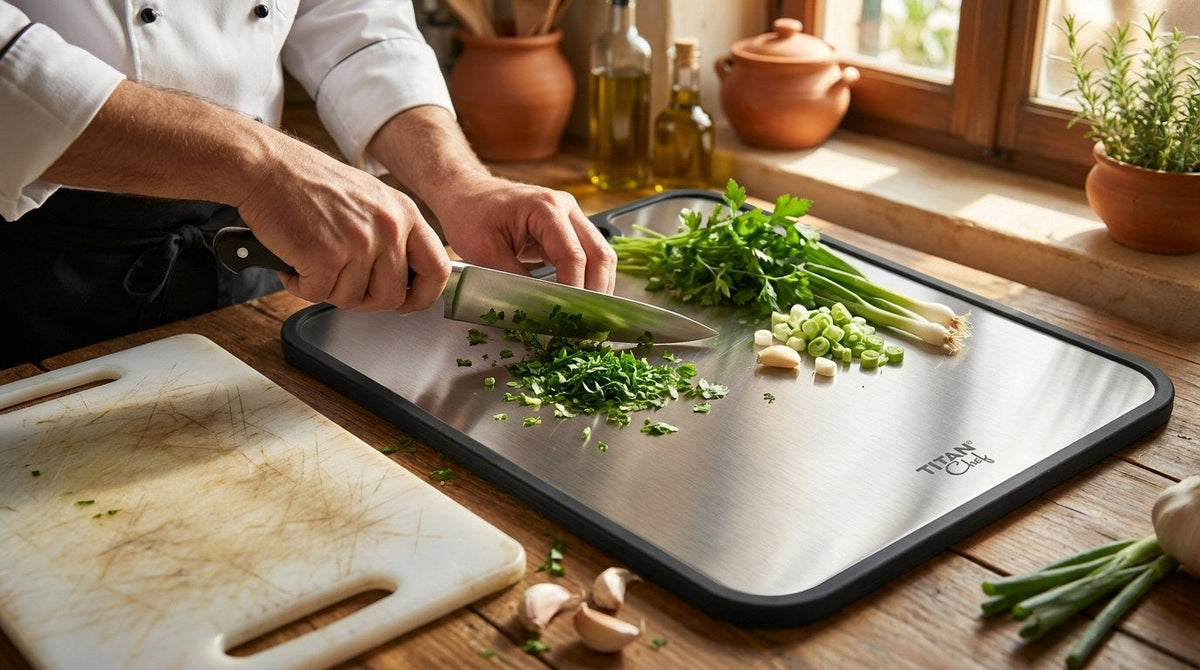
For the cutting board in particular, stainless steel offers a combination of properties that plastic does not have. A stainless steel surface made of 304 stainless steel is a food-grade alloy that contains no bisphenols and does not release microplastics during use. The surface is non-porous, which also means bacteria and odours do not settle in it the way they do in the knife grooves of plastic.
The type of plastic makes some difference, but no plastic cutting board material is completely free of microplastic release. The only way to completely avoid microplastics from cutting boards is to switch to non-plastic alternatives. A TitanChef stainless steel cutting board is dishwasher safe, needs no maintenance and keeps its properties regardless of the number of dishwasher cycles or the amount of cutting.
For an extensive overview of material differences, also take a look at this blog about the cutting board material comparison: plastic, wood, bamboo or stainless steel. And if you want to understand which other kitchen items spread microplastics, also read the blog about the top 10 items in your kitchen that spread microplastics.
Conclusion
The BPA-free label owes its name to one specific substance that has indeed been removed. But the substitutes, BPS and BPF, have comparable hormone-disrupting properties and have now also been designated as hazardous by the EU. At the same time, a BPA-free label changes nothing about the microplastics every plastic cutting board releases with normal use. These are two separate problems that each need their own answer, and the answer to both is the same: choose a material that has neither drawback.
Stainless steel contains no bisphenols, does not release microplastics and needs minimal maintenance. That is not a claim that stands or falls with a label. It simply follows from what the material is.
Looking for a cutting board without plastic? The TitanChef Original is made of 304 stainless steel and does not release microplastics.
Want to know more? Also read are microplastics harmful to your health?
Frequently asked questions about whether BPA-free plastic is still harmful
Is BPA-free plastic really safe, or is it mainly a marketing claim?
BPA-free only says that the product does not contain bisphenol A. It says nothing about the substances that replaced it. According to several scientific studies, the most commonly used substitutes, BPS and BPF, have hormone-disrupting properties comparable to BPA. Several European scientific committees expect some other bisphenols, such as BPS, to have roughly the same harmful properties as BPA. A BPA-free label is therefore no guarantee that a product is free of endocrine-disrupting substances.
So do BPA-free products contain BPS or BPF, and aren't they just as harmful?
In many cases, yes. When manufacturers removed BPA from their products, many switched to bisphenol S (BPS) or bisphenol F (BPF). Research shows that BPS, BPF and BPAF have comparable hormone-disrupting effects. The EU now also bans these substances in food contact materials via Regulation 2024/3190, but because of transition periods, products containing them may remain on the market for some time.
Are microplastics released from BPA-free plastic when you use it for cutting?
Yes. BPA-free or not: if a cutting board is made of plastic, the surface wears with every cut. Scratched plastic boards release microplastics into food: research by Yadav et al. from 2023 shows that a plastic cutting board can release up to 50 grams of microplastics per year with normal use. The more scratches, the more particles come loose. BPA-free status does not change that mechanism.
Does plastic release more harmful substances when it is old or scratched?
Yes, that is well documented. The more scratches a plastic cutting board has, the larger the surface exposed to wear. With normal use, up to 79 million microplastic particles per year can be released. The older and more scratched the board, the more particles come loose. Heat, such as from hot meat on a plastic board, also speeds up the release.
Why does packaging still say BPA-free if BPA is already banned?
Since 20 January 2025, the use of BPA in materials that come into contact with food has been banned. The BPA-free label can still appear on products made before that date, however, because transition periods apply. Materials containing BPA may be placed on the market until 20 July 2026 if they were produced before 20 January 2025. In addition, the label only covers BPA, not the substitutes BPS or BPF. So read the packaging critically: BPA-free is not the same as bisphenol-free.
Is stainless steel really safer than BPA-free plastic?
Yes, on the points that are relevant here. Stainless steel contains no bisphenols and does not release microplastics during cutting. Consumer organisations explicitly recommend glass and stainless steel as safer alternatives to plastic if you want to avoid bisphenols. For the cutting board specifically, a stainless steel surface is also non-porous and does not absorb bacteria and odours the way plastic does over time.
Is BPA-free plastic safe for children?
The scientific consensus is cautious. The European Food Safety Authority lowered the tolerable daily intake of BPA from 4 micrograms to 0.2 nanograms per kilogram of body weight, a reduction by a factor of 20,000. The consumer organisation Test-Aankoop is calling for a complete ban on all bisphenols in products aimed at babies and children. For kitchenware that comes into contact with children's food, a plastic-free material is the most cautious choice.
Below you will find the TitanChef stainless steel cutting boards, along with more blogs if you want to read on.


