



The link between microplastics, a plastic cutting board and your organs is more concrete than most people expect. Every time you draw a knife across a plastic surface, microscopic particles wear off and end up in your food. Through the gut they enter the bloodstream and, over the years, accumulate in organs such as the lungs, liver and brain. Scientific research is bringing that process into ever sharper focus.
What happens when you cut on a plastic cutting board
A plastic cutting board seems like a neutral tool. Cheap, light, easy to clean. But the material, usually polyethylene (PE) or polypropylene (PP), is relatively soft. Every knife that crosses the surface cuts loose invisible particles: microscopic fragments smaller than five millimetres, by definition microplastics, or even smaller than one micrometre, in which case we speak of nanoplastics.
In 2023, researchers at North Dakota State University published a study in Environmental Science & Technology with the telling subtitle: "An Overlooked Source of Microplastics in Human Food?" (Yadav et al., 2023). They cut carrots on PE and PP cutting boards and counted the particles. The result: with daily use, such boards can release up to 50 grams of microplastics per year into food. An estimated half of those particles end up directly on the cut food. The other half is rinsed away when washing up.
A scratched plastic cutting board amplifies this effect. The more wear, the larger the surface that is vulnerable to further abrasion with every cut. An old, heavily used board is therefore not only a greater hygiene risk, but also an ever larger source of microplastics as time goes on. You can read more about that last aspect in our blog about plastic cutting board scratches, bacteria and microplastics after a year of use.
How microplastics from a plastic cutting board reach your organs
Microplastics that enter through food first pass through the digestive tract. Part of them leaves the body via the stool. But the smallest particles, nanoplastics smaller than one micrometre, are small enough to pass through the intestinal wall. Once on the other side, they enter the bloodstream and from there spread to organs throughout the body.
A study published in Environmental Health Perspectives in 2025 (Gan et al., 2025) examined this process directly. For four to twelve weeks, mice were given food prepared on polypropylene and polyethylene cutting boards. Afterwards, the animals had demonstrably higher concentrations of microplastics in their blood and colon, along with signs of intestinal inflammation and changes in the gut flora. It is the first direct evidence that microplastics from a cutting board cause biological effects.
In earlier research, Vrije Universiteit Amsterdam confirmed that polymers such as polyethylene, PVC and PET are demonstrably present in the blood of people in the Netherlands. Those particles enter the bloodstream through food and drink. It is not an abstract future scenario: it is happening in the bodies of people who simply cook and eat.
In which organs do microplastics from a plastic cutting board accumulate
The question of where exactly the particles end up has been answered ever more concretely in recent years. Micro- and nanoplastics have now been found in virtually all human tissues, including blood, lungs, placenta, liver, kidneys and brain. A Dutch knowledge agenda presented to the Dutch parliament in 2025 confirms this: scientists have detected the particles in all of these locations.
Particularly worrying is what research published in Nature Medicine (2025) found in brain tissue. Researchers analysed brain samples from people who died between 1997 and 2024. Concentrations of micro- and nanoplastics in brain tissue were significantly higher than in the liver and kidneys. Samples from 2024 also contained considerably higher concentrations than samples from 2016, which points to accumulation that increases over the years. That polyethylene plays a prominent role here is relevant: it is exactly the material most plastic cutting boards are made of.
What build-up in your organs over the years can mean for your health
Plastic is designed to last. That property also applies once the particles are inside the body. The body has no mechanism to break down polyethylene or polypropylene. Much research is still under way on the exact rate of accumulation and the precise long-term effects, but the evidence already available deserves attention.
The most significant clinical study so far is that of Marfella et al., published in the New England Journal of Medicine in March 2024. Researchers analysed vascular tissue from 257 patients undergoing surgery on the carotid artery. In patients in whom micro- and nanoplastics were found in the removed plaque, the risk of heart attack, stroke or death in the following 34 months was more than 4.5 times higher than in patients without microplastics in their artery wall. That is no proof that cutting boards directly cause this risk, but it shows what is at stake when microplastics accumulate in the bloodstream for years.
Other possible effects research points to: chronic inflammation in the digestive tract, disruption of the gut flora and influence on hormones through plasticisers and BPA-like substances that plastic releases. You can read more about the broader state of the science in our blog about microplastics and long-term health risks.
Microplastics, plastic cutting boards and organs: the alternative that tackles the problem at the source
The cutting board is one of the most controllable sources of microplastics in the kitchen. You cannot easily filter drinking water for nanoplastics, and you cannot avoid all plastic food packaging. But the board you cut on every day is a choice you make yourself, and one you can change tomorrow.
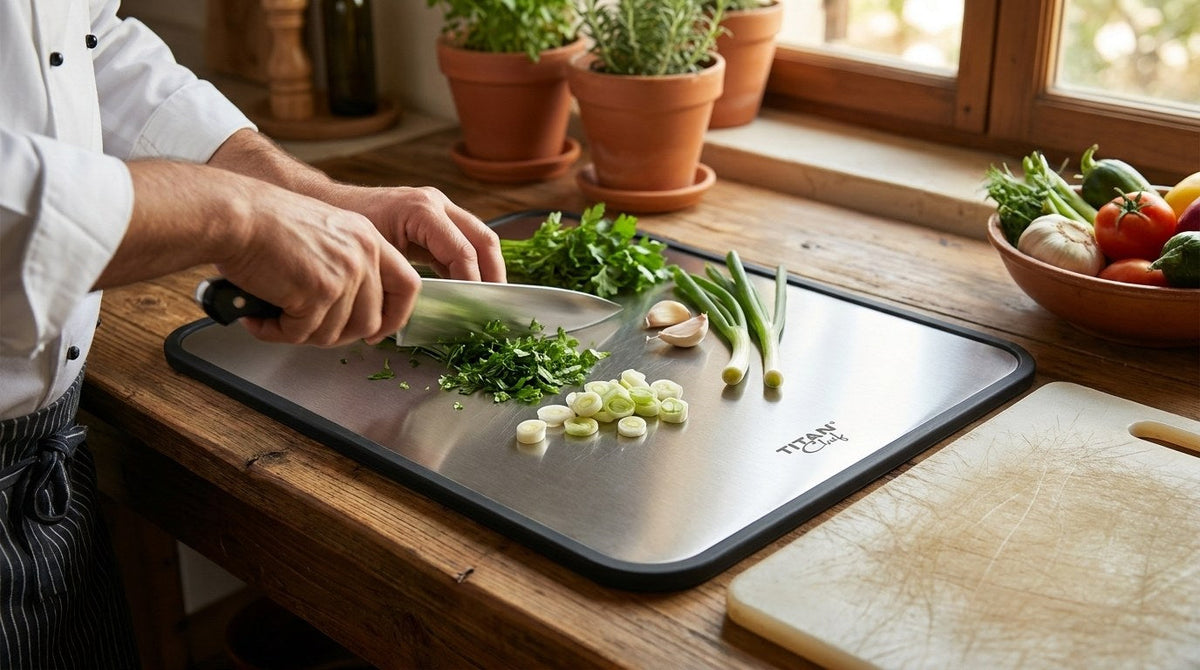
Stainless steel does not wear the way plastic does. A knife does not pull particles out of the material, and no microplastics are released into food. The TitanChef cutting board is made of food-grade 304 stainless steel: non-porous, hygienic, fully dishwasher safe and with no need for oiling or special cleaning products. A one-time choice that removes a daily source of accumulation.
Wood is another option for anyone who wants to avoid microplastics. It needs more maintenance and is less suited to intensive cleaning, but it does not release plastic particles into food. Bamboo often contains synthetic glue that can come loose with wear, which makes that material less clear-cut. A stainless steel cutting board combines hygiene, durability and easy maintenance in one choice.
Looking for a cutting board without those drawbacks? Take a look at the TitanChef Original, made of solid stainless steel.
Also read: Plastic-free cutting board: keep microplastics out of your food.
Frequently asked questions about microplastics, plastic cutting boards and organs
How many microplastics do I take in per year through my plastic cutting board?
Research by Yadav et al. (2023, Environmental Science & Technology) calculated that a polyethylene or polypropylene cutting board can release up to 50 grams of microplastics per year into food with normal daily use. That amounts to tens to hundreds of millions of individual particles per year, depending on the material and how intensively you use the board. Every cut adds to that amount.
Do microplastics from a cutting board really end up in my food, or do they stay on the outside?
They really do end up in your food. Research by North Dakota State University showed that microplastic particles were visibly embedded in the surface of cut vegetables after cutting. An estimated half of the released particles end up directly on the cut food, while the other half stays on the board and is rinsed away when washing up.
In which organs do microplastics accumulate when you take them in through food?
Micro- and nanoplastics have now been found in virtually all human tissues and organs, including the blood, lungs, placenta, liver, kidneys and brain. Research published in Nature Medicine (2025) showed that brain tissue contains relatively high concentrations of microplastics, higher than the liver and kidneys. Concentrations also increase as the years go by.
Does the age or wear of your plastic cutting board affect how many microplastics are released?
Yes, it makes a clear difference. The more scratches and wear on a plastic cutting board, the larger the surface that is vulnerable to further abrasion with every cut. A heavily scratched cutting board therefore releases more microplastic particles than a new one. This means an old plastic cutting board is not only a hygiene risk because of bacteria settling in the scratches, but also becomes an ever larger source of microplastics as time goes on.
Are microplastics you take in through food excreted again, or do they stay in your body?
Part of the microplastics leaves the body via the stool, but that does not apply to all particles, and certainly not to the smallest nanoplastics. Particles smaller than a few micrometres can pass through the intestinal wall, enter the bloodstream and spread from there to organs. How long particles stay in organs exactly, and to what extent the body can break them down, is still the subject of ongoing research.
What is a safe alternative to a plastic cutting board if you want to avoid microplastics?
A stainless steel cutting board is one of the most direct solutions. Stainless steel does not wear the way plastic does: no particles come loose that end up in your food. The TitanChef stainless steel cutting board is made of food-grade 304 stainless steel, is non-porous, hygienic and fully dishwasher safe. Wood is another option, although it needs more maintenance and is less suited to intensive cleaning.
Are children at greater risk than adults from microplastic exposure in the kitchen?
Research suggests that young children take in relatively more microplastics than adults, for example through baby bottles, baby food and toys. Children in the development phase are also more sensitive to disruption of hormonal and neurological processes. For families with young children, the kitchen, and the cutting board in particular, is one of the most direct sources you can eliminate yourself.
Conclusion
The build-up of microplastics from a plastic cutting board in your organs is a process that is already under way with daily use. Particles end up in food, are absorbed through the gut into the bloodstream and accumulate over the years in tissues the body cannot clean. The science is still developing, but the evidence already available, from increased cardiovascular risk to presence in brain tissue, gives enough reason to take seriously the sources you can eliminate yourself. The cutting board is one of them.
Below you will find the TitanChef stainless steel cutting boards, along with more blogs to read.


