



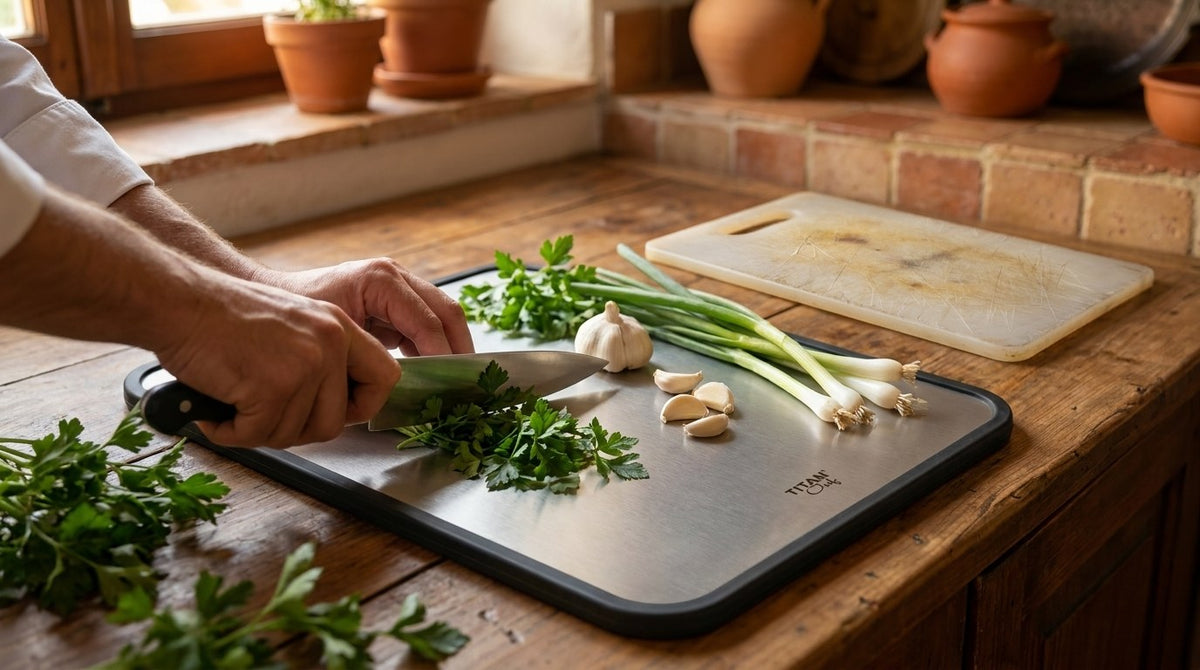
Did you know that the cutting board that has been in your kitchen for years is disappearing into your food bit by bit? Research shows that the microplastics danger of a plastic cutting board is something many people underestimate: with normal daily use, millions of microscopically small plastic particles can end up directly in your food. That is not only a reason for health-conscious home cooks to question their material, it is also why more and more experienced cooks are consciously choosing an alternative.
In this article we look at what research says about plastic cutting boards and microplastics, why bacteria and scratches are a second problem, and which alternatives you can consider if you want to get rid of plastic in your kitchen.
What makes a plastic cutting board a source of microplastics
The principle is simple: every time a knife touches the surface of a plastic cutting board, a small amount of material wears off. Those particles, smaller than five millimetres and therefore microplastics by definition, attach to the moisture in vegetables and meat. That is how they end up in the meal, and then in the body of whoever eats it.
In 2023, researcher Himani Yadav and her team at North Dakota State University published a study in the scientific journal Environmental Science and Technology that systematically mapped this mechanism. They cut carrots on polyethylene and polypropylene cutting boards, the two most common plastics for cutting boards, and measured how many particles were released. The findings were striking: with daily use, a polypropylene cutting board can release up to 79 million microplastic particles per year (Yadav et al., 2023). With polyethylene, it comes to around 14 to 72 million particles. Up to 15 individual particles can be released per cut.
Expressed in weight: a plastic cutting board can release up to around 50 grams of microplastics per year into your food during normal use. The researchers described cutting boards as "an overlooked source" of microplastic exposure. That is exactly why the microplastics danger of plastic cutting boards stayed under the radar for so long: it is not visible, it is not conscious, and it happens again with every meal.
Bacteria and scratches: the second problem with plastic cutting boards
Besides microplastics, there is a second reason to take a critical look at plastic as a cutting board material. As soon as scratches appear in the surface, the structure of the board changes fundamentally. Food residue and moisture seep into the microscopic grooves. Bacteria such as Salmonella and E. coli can settle and multiply there, protected by the material itself.
The problem with these scratches is that they no longer close. Plastic does not "remember" its original structure. A groove created by chopping a piece of pumpkin or cutting raw chicken stays. Even thorough scrubbing and washing does not always remove all the bacteria that have retreated deep into those grooves. The older a plastic cutting board, the more knife marks, and the greater the risk of bacteria from raw meat on the cutting board.
At the same time, a board with more scratches also releases microplastics faster. The two problems reinforce each other: a worn plastic cutting board is both a bacteriological risk and a growing source of plastic particles in your food.
What research says about the health risks of microplastics
Whether taking in microplastics via cutting boards is harmful in the long term is currently being widely researched. Science has not reached the end of the road here, but the interim signals are serious enough to pay attention to.
Microplastics have now been found in human blood, in lung tissue and in the placenta of pregnant women. A clinical study published in the New England Journal of Medicine in 2024 found a link between the presence of microplastics in patients' vessel walls and an increased risk of cardiovascular events (Marfella et al., 2024). Research from 2025 found microplastics in human brain tissue, with three to five times as many plastic fragments found in people with dementia as in healthy controls (Nihart et al., 2025).
What exactly this means in the long term for people who take in small amounts of microplastics through their food every day is still being studied. There are indications that microplastics can trigger inflammatory reactions and may affect hormone balance. Scientists agree that more research is needed, but also that caution is already justified now. Replacing a cutting board is one of the simplest steps you can take to remove this source of exposure. You can read more about exactly what the research says in our article about microplastics and long-term health risks.
Why professional kitchens work with colour-coded plastic boards
In the hospitality industry, plastic is the standard cutting board material, but not for the reasons you might think. It is not about hygiene or health in the sense of microplastics. It is about the HACCP system: Hazard Analysis and Critical Control Points, a mandatory European food safety standard for anyone who prepares food professionally.
That system requires the use of colour-coded HDPE plastic cutting boards. Red for raw meat, blue for fish, green for fruit and vegetables, yellow for poultry, white for bread and cheese. Each board has its own colour and is used strictly for one category of ingredients. The aim is to prevent cross-contamination in an environment where dozens of meals are prepared at the same time every evening (Regulation (EC) No 852/2004 on the hygiene of foodstuffs).
This system is designed for the pressure of a professional kitchen, not for the home. At home you rarely use six boards at once, and the amount of cutting per day is much lower than in a restaurant. In addition, the professional kitchen works with turnaround times and cleaning protocols that do not match how people cook at home. The HACCP system makes plastic practical in hospitality, but that says little about whether plastic is the best choice at home.
Wood as an alternative: what works and what does not
Wood is the material many cooks instinctively fall back on when they want to get rid of plastic. And there are good reasons for that. Hardwood is gentle on knives, feels pleasant to cut on, and bacteria behave differently on wood than was long assumed. Research suggests that with some types of wood, bacteria are drawn deeper into the fibres, where they die off because the wood effectively traps them.
But wood also has clear limitations. The surface is porous, which means moisture, odours and food residue can soak into the material. Regular oiling is necessary to keep the board in good condition. Wood cannot handle the dishwasher: the combination of heat, water and detergent damages the fibres, which can cause the board to warp or crack. With intensive use with juicy ingredients or raw meat, wood requires more attention than most home cooks are happy to give it.
For anyone looking for a cutting board that lasts for years without a maintenance ritual, wood is not the most practical choice, even though the material itself is a lot better than plastic when it comes to microplastics.
A stainless steel cutting board as an alternative: the benefits at home
A stainless steel cutting board solves the two core problems of plastic. Stainless steel does not wear down the way plastic does: no microplastics end up in your food. The surface is non-porous, which means bacteria and moisture do not penetrate the material. After cutting raw meat or fish: rinse it, or simply put it in the dishwasher.
304 stainless steel, the material used for food-grade cutting boards, can withstand the combination of heat, detergent and water in a dishwasher. No oil needed, no special cleaner, no hand-washing ritual. Both sides can be used, which makes it easy to keep raw meat and vegetables separate: use one side for one, flip it over for the other.
The brushed finish of a good stainless steel cutting board gives just enough micro-texture for pleasant cutting, without the surface itself being prone to scratches in a way that affects its function. Small marks of use are normal for the material, just as they are for a good wooden butcher's block, and have no effect on hygiene or performance. The TitanChef stainless steel cutting board combines these properties in a sleek, modern design that can stay out on the worktop without any problem.
If you want to know more about how to keep a stainless steel cutting board in good condition for a long time, there is a detailed guide on cleaning a stainless steel cutting board and keeping it in top condition.
The microplastics danger of plastic cutting boards: what you can do yourself
The cutting board is one of the easiest sources of microplastics to remove from your kitchen. You do not need a major lifestyle change, no filter, no subscription. One board out, another one in. That is it.
If you still use a plastic cutting board, these are the most useful steps:
- Check the surface for knife marks and discolouration. If they are visible, the board needs replacing.
- Never use a clearly damaged plastic cutting board for ingredients that are eaten raw, such as vegetables for a salad or fruit.
- Consider switching to a material that does not release microplastics: wood (with the maintenance that comes with it) or stainless steel (easier to maintain, dishwasher safe).
- When choosing an alternative, check whether the material really is non-porous. Bamboo and some composite materials fall into a grey area and are not necessarily better than wood or stainless steel.
A good comparison of all materials, including the pros and cons per situation, can be found in the article cutting board material comparison: plastic, wood, bamboo or stainless steel.
Looking for a cutting board without plastic? The TitanChef Original is made of 304 stainless steel and does not release microplastics.
Want to know more? Also read a cutting board without plastic: how to avoid microplastics in your food.
Frequently asked questions about plastic cutting boards and microplastics
How many microplastics are released when cutting on a plastic cutting board?
Research by North Dakota State University (Yadav et al., 2023) shows that cutting carrots on a polypropylene cutting board can release up to 79 million microplastic particles per year. With a polyethylene board, it comes to around 14 to 72 million particles. Up to 15 individual particles can be released per cut. The exact amount depends on the age of the board, the sharpness of the knife and the hardness of the ingredient.
What are the dangers of an old plastic cutting board?
An older plastic cutting board has more scratches, and every scratch is a double problem. First, more microplastics are released as the surface wears more. Second, bacteria such as Salmonella and E. coli settle in the microscopic grooves, where they can survive even thorough cleaning. A plastic cutting board with visible knife marks is best replaced, because the surface does not repair itself.
Which cutting board is the most hygienic: wood, plastic or stainless steel?
The main advantage of stainless steel is that the surface is non-porous: bacteria and moisture do not penetrate the material, and no knife grooves form in which residue can build up. Wood behaves differently than was long assumed: the fibres in hardwood can draw bacteria inside and then kill them, although the surface remains harder to disinfect than stainless steel. Plastic seems practical but has two drawbacks: scratches give bacteria hiding places, and the surface releases microplastics into food.
What is HACCP and which cutting board do you use for it in a professional kitchen?
HACCP stands for Hazard Analysis and Critical Control Points, a mandatory European food safety system for anyone who prepares or processes food professionally. In the hospitality industry, colour-coded HDPE plastic cutting boards are used to prevent cross-contamination: red for raw meat, blue for fish, green for vegetables, and so on. This colour system requires several boards per kitchen, which is not practical at home. At home, a stainless steel cutting board that you can use on both sides works well as an alternative to that separation.
Which cutting board is best if you no longer want to use plastic?
The two most obvious alternatives are wood and stainless steel. Wood is gentle on knives but needs maintenance: regular oiling, no dishwasher, and the board can warp or crack over time. Stainless steel is non-porous, dishwasher safe, does not release microplastics and is easy to keep clean. For anyone looking for a cutting board that lasts for years without maintenance, a stainless steel cutting board is the most practical choice.
When should you throw away a plastic cutting board?
As soon as a plastic cutting board shows visible knife marks, grooves or discolouration, it is time to replace it. At that point the surface actively releases more microplastics than a new board, and the scratches give bacteria more hiding places. Most plastic cutting boards last one to three years with normal use before they need replacing. If you want to avoid that hassle, choose a material that does not wear down in that way.
Conclusion
The microplastics danger of plastic cutting boards is now scientifically supported: research shows that plastic cutting boards can release millions of microplastic particles per year into food with daily use. On top of that come the bacteriological risks of scratches. If you want to cook consciously and are looking for a long-term solution, you have good reasons to replace plastic with a material that does not have this problem. Stainless steel combines non-porous hygiene with dishwasher safety and a long lifespan, without any maintenance obligations. It is a choice you make once and never have to revisit.
Below you will find the TitanChef stainless steel cutting boards, plus more blogs to read if you want to know more about healthy cooking and the right kitchen materials.


