



Not every cutting board handles the dishwasher equally well. One board comes out perfectly straight, another warps before the cycle has even finished. And sometimes it seems as if the dishwasher solves the problem, while the real hygiene problem simply stays put. In this blog you will read per material what you can expect, which cutting board is dishwasher safe and which is better kept out, and why that matters in practice.
Why the dishwasher is not suitable for every cutting board
A dishwasher works with a combination of high water temperatures, prolonged contact with moisture and powerful detergents. For most kitchenware that is not a problem. For cutting boards it depends entirely on the material: some materials absorb moisture and react to changes in temperature, others do not.
So it is not just a question of whether a board survives the wash cycle. The follow-up question is just as important: does the dishwasher also solve the hygiene problem? For some materials the answer is more nuanced than you might think.
Wooden cutting board in the dishwasher: warped and damaged
Putting a wooden cutting board in the dishwasher is a bad idea, and that is no exaggeration. Wood is a living material that expands with moisture and shrinks when dry. In the dishwasher that process happens quickly and unevenly: the outside dries faster than the inside, which leads to cracking, splitting and warping. The board loses its flat shape, so it starts to wobble on the worktop. That is annoying while cutting, but also a safety risk.
On top of that, the glue that holds the strips of laminated wooden boards together comes loose under the heat. Once cracked or split, the surface actually offers more hiding places for bacteria, exactly the opposite of what you want. Wooden cutting boards warping after the dishwasher is therefore one of the most familiar complaints about this material.
Cleaning a wooden cutting board is better done by hand: warm water, a little washing-up liquid, rinse well and let it dry upright so both sides can breathe. In addition, oil the board about once a month with a food-safe mineral oil, not with olive oil or sunflower oil because they go rancid. Odours that have soaked into the wood can be removed with half a lemon or coarse salt. It takes a little more time than loading the dishwasher, but it keeps your board in good condition for longer.
As for hygiene: wood has natural antibacterial properties. Researchers at the University of Wisconsin showed that bacteria such as Salmonella and E. coli die off by themselves on a wooden board within a few hours. That applies to a well-maintained, undamaged board. As soon as the wood is deeply damaged or cannot dry properly, that advantage disappears.
Plastic cutting board in the dishwasher: the problem runs deeper
Technically, a plastic cutting board handles the dishwasher perfectly well. That is exactly why plastic boards are so popular: light, cheap and straight into the machine after use. The only problem is that the dishwasher does not solve the real hygiene problem.
Plastic cutting board bacteria settle in the knife grooves that form through use. Scratches in plastic are not superficial: they are small crevices into which food residue and moisture disappear. Even after a good wash, bacteria remain in the deepest grooves. Research confirms that heavily scratched plastic boards can retain bacteria, even after thorough cleaning. At room temperature there is even a chance that the bacteria will multiply further afterwards.
There is a second problem that is only recently getting the attention it deserves. Every cut on a plastic board releases small plastic particles. Research by Yadav et al. (2023, North Dakota State University), published in the scientific journal Environmental Science and Technology, calculated that a polyethylene or polypropylene cutting board can release up to 50 grams of microplastics per year with normal use, directly into the food you prepare. The more scratches, the more particles come loose. The dishwasher does not change that: it washes the surface clean, but the knife grooves that release the particles remain.
A scratched plastic cutting board therefore has a double problem: bacteriological via the grooves, and chemical via the microplastics that come along with every meal. If you want to read more about which kitchen materials spread microplastics, the blog about the top 10 items in your kitchen that spread microplastics gives a broader overview.
Bamboo cutting board in the dishwasher: similar to wood
Bamboo is often presented as a sustainable and strong alternative to wood. The material is indeed harder than most types of wood, so it wears less quickly. But when it comes to the dishwasher, bamboo behaves similarly to wood.
The bamboo strips in a cutting board are glued together during production. That glue comes loose under the heat and prolonged damp conditions of a dishwasher. Once it lets go, gaps and cracks form in the surface, making the material more brittle and harder to keep hygienic. Manufacturers of bamboo cutting boards almost always recommend hand washing. If in doubt, check the product information of your specific board.
Bamboo has one more point: the material naturally contains more silica than wood, which makes knives go blunt a little faster than on a comparable wooden board. That is no reason to avoid bamboo, but it is something to keep in mind if you want to look after good knives.
Which cutting board is dishwasher safe: stainless steel as the clear answer
A dishwasher-safe stainless steel cutting board is not a marketing claim, it is simply what the material is by nature. Stainless steel is non-porous: it does not absorb moisture, does not react to temperature changes and is not affected by the detergents a dishwasher uses. After the wash cycle, the board is immediately ready for use, without drying in a specific position, without oiling and without extra maintenance.
Research by Wageningen University, quoted by the Dutch consumer programme Radar, confirms that a smooth, non-porous surface such as stainless steel is easier to keep clean than a porous material such as wood or a scratched plastic surface. Stainless steel gives bacteria less grip: there are no fibres, pores or knife grooves into which food residue can disappear.
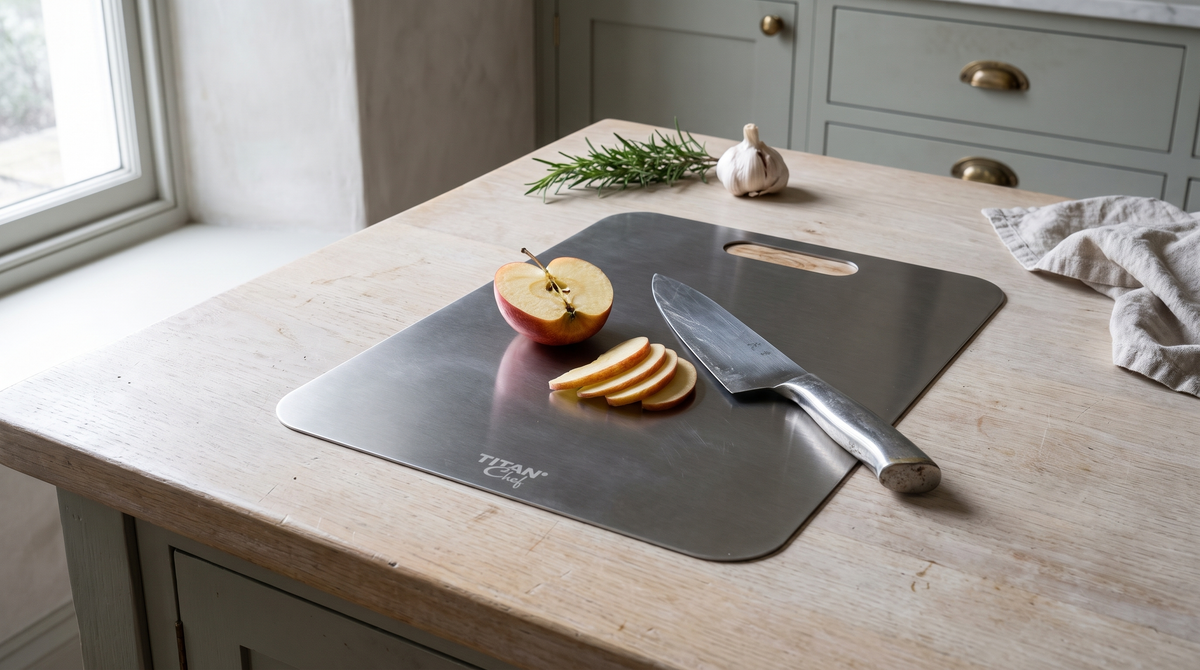
A dishwasher-safe cutting board that is also microplastic-free is therefore the logical combination. Stainless steel does not wear in a way that releases particles into your food. The TitanChef stainless steel cutting board is made of 304 stainless steel, the food-grade quality level recognised as safe for direct contact with food. That applies to both the Original model (39 x 28 cm, 1.2 mm thick) and the PRO version, which also has a non-slip rubber edge and a raised rim that keeps juices on the board when cutting juicy meat or fruit.
Scratches on a stainless steel board are purely cosmetic. They have no influence on the hygiene or functionality of the surface, because stainless steel remains non-porous even after the brushed finish shows some marks. That is an essential difference from plastic, where the scratches are exactly where the problem starts. For more background on how cutting board scratches and hygiene are connected, also read the blog about plastic cutting board bacteria and scratches: why a stainless steel cutting board is better.
Which cutting board is dishwasher safe: overview per material
The answers per material at a glance, so you can compare quickly:
- Wood: not in the dishwasher. The wood warps, cracks or splits because of the heat and prolonged damp contact. Hand washing and regular oiling are the right approach.
- Plastic: technically dishwasher safe, but the dishwasher does not solve the real problem. Scratched plastic boards retain bacteria in the grooves and release microplastics into food, even after washing.
- Bamboo: generally not recommended for the dishwasher. Bamboo reacts similarly to wood: the glue comes loose and the material cracks. Hand washing is the safe option.
- Stainless steel: fully dishwasher safe. The material is non-porous, does not absorb moisture and is not affected by heat or detergents. No extra maintenance needed.
Cutting board maintenance and hygiene: what makes the difference in practice
Choosing a dishwasher-safe cutting board is not just a matter of convenience. It is also about how easily you can actually keep a board hygienic over a longer period. A plastic board starts out clean, but degrades through use. A wooden board needs active maintenance to stay in good condition. A stainless steel board does not change character through use: the surface remains non-porous, no matter how long or how intensively you cut on it.
For anyone working with raw meat or fish, that is relevant. The Dutch RIVM names cross-contamination via the cutting board as one of the most common routes by which food infections arise in the home kitchen. A board you can clean quickly and thoroughly after contact with raw meat, without any doubt about what stays behind in the grooves, makes that step easier.
After use, you can rinse a stainless steel cutting board with warm water and washing-up liquid or put it straight in the dishwasher. Both sides can be used, which also makes it easier to keep raw meat and vegetables strictly separate by simply flipping the board over.
Going for stainless steel? The TitanChef Original is a 304 stainless steel cutting board that lasts for years.
Want to know more about the differences? Also read comparing cutting board materials: plastic, wood, bamboo or stainless steel.
Frequently asked questions about which cutting board is dishwasher safe
Can a wooden cutting board go in the dishwasher?
No. The combination of high temperatures, prolonged contact with water and aggressive detergents almost certainly causes a wooden cutting board to warp, crack or split. The wood shrinks and expands unevenly, so the board loses its flat shape and cracks become hiding places for bacteria. Wash a wooden board by hand in warm water with a little washing-up liquid and let it dry upright.
Does a wooden cutting board warp in the dishwasher?
Yes, that is one of the most common problems. Wood is a living material that expands and shrinks depending on humidity and temperature. The high heat in a dishwasher speeds up that process sharply and unevenly. The result is a board that wobbles on the worktop, which is awkward while cutting and bad for hygiene, because cracks become a breeding ground for dirt.
Can a plastic cutting board go in the dishwasher?
Technically, a plastic cutting board can handle the dishwasher. Yet the dishwasher does not solve plastic's biggest problem. As a plastic board gets more scratches from knife use, bacteria settle deep in those grooves, and even after a full wash they stay there. In addition, scratched plastic boards release microplastics into food: research by Yadav et al. (2023, North Dakota State University) calculated up to 50 grams of microplastics per year with normal use.
Can a bamboo cutting board go in the dishwasher?
Generally not. Bamboo is harder than most types of wood, but reacts to moisture and heat in the same way: the boards can crack and the glue between the bamboo strips comes loose. The surface then becomes more brittle and harder to keep clean. Manufacturers almost always recommend hand washing for bamboo cutting boards, but always check the product information of the specific board you have.
Which cutting boards are dishwasher safe?
Stainless steel cutting boards are fully dishwasher safe. The material is non-porous, does not absorb moisture and withstands the high temperatures and detergents in a dishwasher. Technically, plastic cutting boards can also handle the dishwasher, but the wash does not solve the real problem, namely bacteria in the scratches and the release of microplastics.
How do I clean a wooden cutting board if it cannot go in the dishwasher?
Wash the board straight after use with warm water and a little washing-up liquid, rinse well and let it dry upright so both sides can breathe. For odours that have soaked into the wood, rub the board with half a lemon or coarse salt. Oil the board about once a month with a food-safe mineral oil to prevent drying out and cracking. Olive oil or sunflower oil are not a good choice: they go rancid and give off an unpleasant smell.
Is a stainless steel cutting board dishwasher safe?
Yes. A stainless steel cutting board made of food-safe 304 steel is fully dishwasher safe. The material does not react to heat, does not absorb moisture and is not affected by detergents. After the wash, the board is immediately ready for use, without extra maintenance such as oiling or drying in a particular position.
Are plastic cutting boards hygienic, even after the dishwasher?
A new, undamaged plastic board is reasonably easy to keep clean. Once knife grooves appear, that picture changes. Bacteria settle in the scratches and are hard to get out, even after a wash in the dishwasher. If you keep cutting on a plastic board, you also run the risk of taking in microplastics through your food, a problem the dishwasher does not solve.
How often should I replace a cutting board?
That depends strongly on the material. A plastic cutting board with deep scratches and discolouration is best replaced every one to two years, sometimes sooner with intensive use. A well-maintained wooden board lasts much longer, but replace it as soon as deep cracks or splits appear that can no longer be cleaned properly. A stainless steel cutting board has no fixed replacement period with normal use: the material does not wear in a way that affects hygiene or functionality.
Conclusion: which cutting board is dishwasher safe
The question of which cutting board is dishwasher safe has a clear answer per material. Wood and bamboo do not belong in it: the heat and prolonged damp contact damage the material and leave cracks that actually hold more bacteria. Plastic technically handles the dishwasher, but the wash does not solve the real problem of scratched boards that release microplastics. Stainless steel is the only cutting board material that fully handles the dishwasher while not holding bacteria in pores or grooves and not releasing particles into your food.
For anyone who wants a board that can simply go in the dishwasher after use and then be clean and microplastic-free without any doubt, a stainless steel cutting board is the most practical choice.
Below you will find the TitanChef stainless steel cutting boards. You will also find more blogs there if you want to read on.


